




Author: Sam Rivera Date: July 3, 2026 Reading Time: 12 minutes
The first male sex toy I ever bought arrived in a box labeled “Silicone Product.” I stared at that box on my doorstep for a solid two minutes before picking it up. Not because it was heavy. Because I was a grown man who’d just spent $45 on something I’d never admitted out loud I was curious about, and even though nobody was watching, I felt like everybody was.
I brought it inside. I hid it in my closet. I waited until that night when I was home alone, then opened it like I was defusing a bomb.
That was three years ago. Since then I’ve tested more male toys than I can count, and I’ve realized something that nobody told me at the beginning: pretty much every guy follows the same path. Search. Buy. Feel weird about it. Try it once. Feel confused. Try it again. Get the hang of it. Realize it’s genuinely good. Wonder why they waited so long.
This guide isn’t going to lecture you about prostate anatomy or give you a clinical breakdown of nerve endings. Other articles do that just fine. What I’m offering is something more useful: an honest walkthrough from a normal guy who’s been where you are, answering the questions you actually have — not the ones a textbook thinks you should have.
Said every guy ever, before trying a toy.
Here’s the thing: your hand does work fine. That’s not the point. The point is that your hand does exactly one thing the exact same way every single time. It’s reliable, sure. But “reliable” and “interesting” are not synonyms.
A good male toy changes two things:
Texture. Your hand has five fingers and a palm. A stroker has internal ridges, spirals, nubs, suction chambers — patterns your hand literally cannot reproduce. When one of those textures hits at the right angle, the sensation is so different from what you’re used to that your brain short-circuits for a second. That’s not marketing language. That’s what happens.
Pace and pressure variability. Your hand operates on muscle memory. After about 30 seconds, it settles into a rhythm you don’t even control consciously. A toy doesn’t have muscle memory. A manual one requires deliberate movement. An automatic one removes movement entirely. Either way, the experience is not on autopilot.
There’s also a psychological layer here that most guides won’t touch. Using a toy means letting yourself be pleasured rather than producing pleasure. For a lot of men, that’s unfamiliar territory. We’re socialized to be the one doing, performing, making things happen. A toy asks you to receive. That shift alone is worth the price of admission.
Bottom line: you’re not replacing your hand. You’re discovering a kind of good your hand literally cannot produce. That’s not a criticism of your hand. It’s a fact about physics.
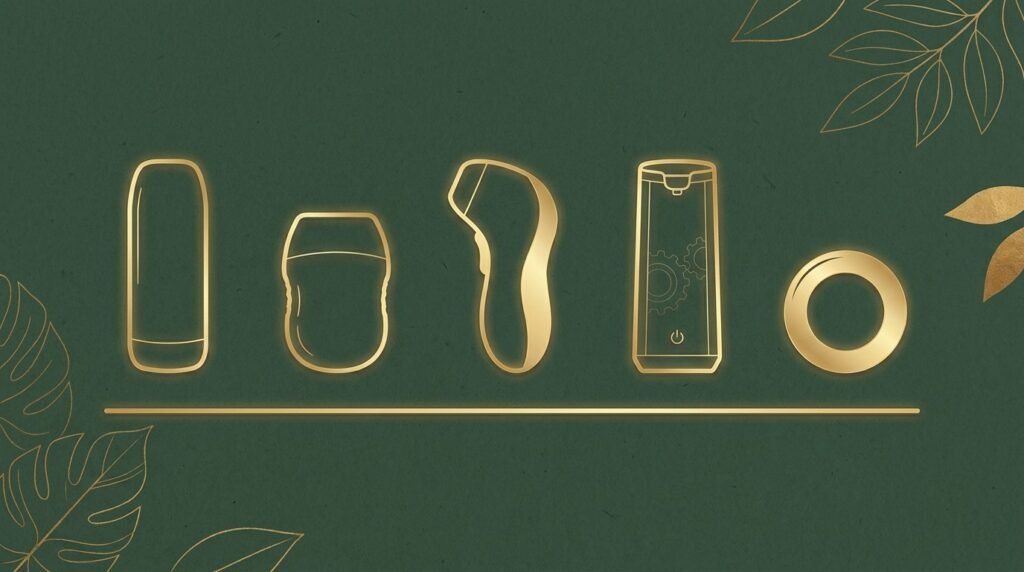
Skip the overwhelming catalog pages. Here’s everything on the market, filtered through the only lens that matters: where you are right now.
Think of this as an assist, not a replacement. It’s an open-ended silicone or TPE sleeve with internal texture. You hold it, insert yourself, and move it the way you’d normally move your hand — except the texture does the work your palm never could.
Best for: The guy who’s curious but suspicious. You don’t want to commit to a full toy. You’re wondering if this whole category is a waste of money. A stroker is the lowest-risk way to find out.
Upside: Cheap, simple, intuitive. No learning curve. Downside: Still manual. If you’re hoping for a hands-free experience, this isn’t it.
Pre-lubricated, single-use, designed to be thrown away after. The interior is soft TPE with a textured channel. You open the package, use it, toss it. There’s nothing to clean.
Best for: The guy who wants to try this without owning a sex toy. No storage. No cleaning routine. No evidence. The disposable route lets you sample the category without committing any space in your drawer — or your identity.
Upside: Zero maintenance. Genuinely disposable. Downside: Adds up if you use them regularly. Not environmentally friendly. Limited texture variety.
A closed-body sleeve, usually with a hard outer shell and soft internal canal. Textured, sometimes with adjustable suction. This is the product most people picture when they think “male sex toy.”
Best for: The guy who tried a stroker or a disposable, liked it, and wants the real thing. This is your first “actual product.”
What to check before buying:
Motorized. Does all the moving for you. Usually combines suction, vibration, and a stroking mechanism. Some have heating elements. Some have app controls. All of them are aggressively marketed.
Best for: The guy who already knows he likes manual toys and wants to upgrade to hands-free. Not for first-timers. If you don’t know what kind of texture or sensation you like yet, a $120 automatic device is an expensive way to find out.
Upside: Truly passive. Lie back and let it work. Can produce sensations that manual effort can’t match. Downside: Louder than manual options. Heavier. More parts to clean. If it breaks, you’re out $100+ with no warranty most companies will actually honor. Learn the basics on a $50 manual sleeve before you invest.
Worn around the base of the penis, sometimes behind the testicles. Restricts blood flow out of the penis, which means: harder erections, longer duration, and — in vibrating models — direct stimulation for both partners during sex.
Best for: The guy who wants to enhance partnered sex, not replace solo sessions. This is the only category designed specifically for two people to use together.
Vibrating models: Add clitoral stimulation for her during intercourse. If you’re looking for a first couples toy rather than a solo toy, start here.
Safety note: Do not wear for more than 20–30 minutes continuously. Remove immediately if you feel numbness, coldness, or pain. Circulation is not a joke.

If you read nothing else in this section, read this:
| If you’re… | Start with… |
|---|---|
| “Still not sure this is worth money” | Stroker ($20–40) |
| “I don’t want to clean anything” | Disposable cup ($10–20) |
| “I’m ready for a real product” | Reusable masturbator ($40–80) |
| “Manual isn’t cutting it anymore” | Automatic masturbator ($60–150) |
| “I want something for me + her” | Vibrating cock ring ($15–50) |
Guides love to tell you what should happen. I’m going to tell you what actually happened to me, because the gap between those two things is where most guys give up.
Opening the box. The packaging was discreet — plain cardboard — but the product inside was aggressively not. Bright red silicone. An internal texture that looked like something from a sci-fi movie. My first thought was: What did I just buy? My second thought was: Does everyone feel this weird?
They do.
The first use. I applied lubricant the way the instructions said — “generously.” I positioned myself. I started.
And it felt… fine? Not bad. Not transcendent. Just different. The texture was there, but I couldn’t tell if I liked it or if it was just in the way. After a few minutes I finished, cleaned up, and felt a very specific kind of disappointment. The kind where you’re not angry you tried it, but you’re also not planning to try it again.
The second time, two nights later, was different. I knew what to expect. My body wasn’t surprised by the sensation. For the first time, I noticed the texture instead of just being aware of it. One ridge in particular — a spiral about two inches in — hit at exactly the right angle, and for a split second my brain went somewhere my hand had never taken it.
That was the moment.
What I learned: Male toys are not instant gratification. Your body needs time to learn a new kind of sensation. Think of it like your first time having sex — nobody’s first time was their best time. The toy is the same. Give it 3–4 sessions before you decide.
The cleaning ritual. Here’s the part nobody writes about and everyone needs: after you finish, you’re holding a lubricated, used silicone sleeve that needs to be washed. If you live with other people, you’re now navigating to the bathroom trying not to look suspicious. If you feel ridiculous, welcome to the club. Everyone does. It gets less weird.
Male toys need more maintenance than any other sex toy category, and most people don’t realize this until their first sleeve starts smelling like a gym bag.
You cannot put a damp sleeve in a drawer and close it. Bacteria breeds in moisture, and TPE absorbs it. A sleeve stored wet will:
The drying routine:
TPE gets sticky over time as oils from the material rise to the surface. When your sleeve starts feeling tacky instead of smooth, it needs powdering. Products labeled “Renewal Powder” or “Toy Refresh Powder” are literally just cosmetic-grade cornstarch. Do not use kitchen cornstarch — food-grade products contain additives.
Lightly dust the exterior, rub it in, shake off the excess. Your sleeve will feel like new.
Back in its original box, or in a dedicated cloth pouch. Not loose in a drawer where it touches other materials, picks up lint, or gets crushed under a stack of t-shirts. Keep it clean, keep it dry, keep it separate.
This is the question most guys don’t ask because they’ve already decided the answer is “I won’t tell her.”
I get it. The mental math goes: If I tell her, she might think our sex isn’t enough for me. She might think I’m weird. She might just look at me differently and I won’t know why.
Here’s the thing: for most women, the actual issue isn’t the toy. It’s whether the toy means something about them.
So lead with that. Don’t say “I got this thing.” Say:
“I bought a toy for myself. I want you to know — this has nothing to do with you. Our sex is good. I’m just curious about trying something different on my own sometimes, the same way you probably have things you do on your own.”
What you’re doing there: you’re acknowledging the fear she might have, before she has to say it. That’s the difference between a conversation that works and one that doesn’t.
If she seems interested: “If you ever want to watch, or use it on me — that’s up to you. Zero pressure.”
Handing the control to your partner is the single most effective way to make a toy feel like a shared thing rather than a secret thing. A lot of women discover they enjoy operating male toys — pacing, teasing, controlling the intensity — in ways that surprise both of you.
If she seems uncomfortable: Let it go. Don’t push. Say “no problem, it’s just a thing I wanted to be honest about.” Her reaction isn’t a verdict on you. It might just mean she needs time to process.

“Will using a toy make it harder to orgasm during real sex?”
Short answer: not if you vary how you masturbate. The problem isn’t toys — it’s doing the exact same thing every time and training your body to only respond to that one specific pattern. Alternate between your hand and your toy. Use different grips, different speeds. Your body stays adaptable. The issue most “death grip” articles describe is caused by monotony, not by the tool.
“Will these toys make me last longer or shorter?”
Neither by default. What they can do is help you learn your own arousal curve. When you’re consciously controlling pace with a stroker — rather than running on autopilot — you start noticing when you’re at a 6 out of 10 versus a 9 out of 10. That awareness transfers to partnered sex.
“Are automatic masturbators really worth the money?”
The $60 ones usually aren’t. The $100–150 ones from established brands usually are — if you know what you like. This is not a category to enter blind. Use a $30 manual sleeve for a month first. When you know what kind of texture and pace you respond to, then the investment makes sense.
“What’s the deal with cock rings and safety?”
Don’t wear one longer than 20–30 minutes. Don’t sleep in one. Don’t use a metal one as your first ring — silicone or TPE gives you an escape option. If you feel numbness, tingling, coldness, or pain, remove it immediately. These are signs of restricted blood flow. Healthy circulation returns within minutes of removal. Ignoring the signs does not.
“Can I use it without lube?”
No. The internal texture of any masturbator will grip skin directly and cause friction burns. Lube is not optional. Water-based for silicone toys. Silicone-based for TPE (but never silicone-on-silicone — it bonds and ruins the material). See our Lube Guide for the full breakdown.
Men’s sexuality gets flattened into something it isn’t. You’re supposed to always be ready, never need help, never be curious, and definitely never use a tool to make yourself feel good. That isn’t masculinity. That’s performance anxiety dressed up as confidence.
Buying a toy doesn’t diminish anything about who you are. It means you understand your own body well enough to know it can feel more than one kind of good. That’s not weakness. That’s self-awareness.
You don’t need to tell anyone. You don’t need to explain it. But you also don’t need permission. If you’re curious, you’re allowed. Simple as that.
Ready to try? Browse our Male Toys collection — discreet packaging, body-safe materials, zero judgment. Every product tested by real people, not marketing departments.
About the Author:
Sam Rivera is a pleasure educator and product reviewer at AmorSerere. With a background in relationship psychology and years of hands-on testing, Sam writes about sex, intimacy, and the tools that make both better. His approach: honest talk, no performance, and never making you feel stupid for asking a question.
Last Updated: July 3, 2026

Writer and relationship coach focused on intimacy, communication, and connection.