


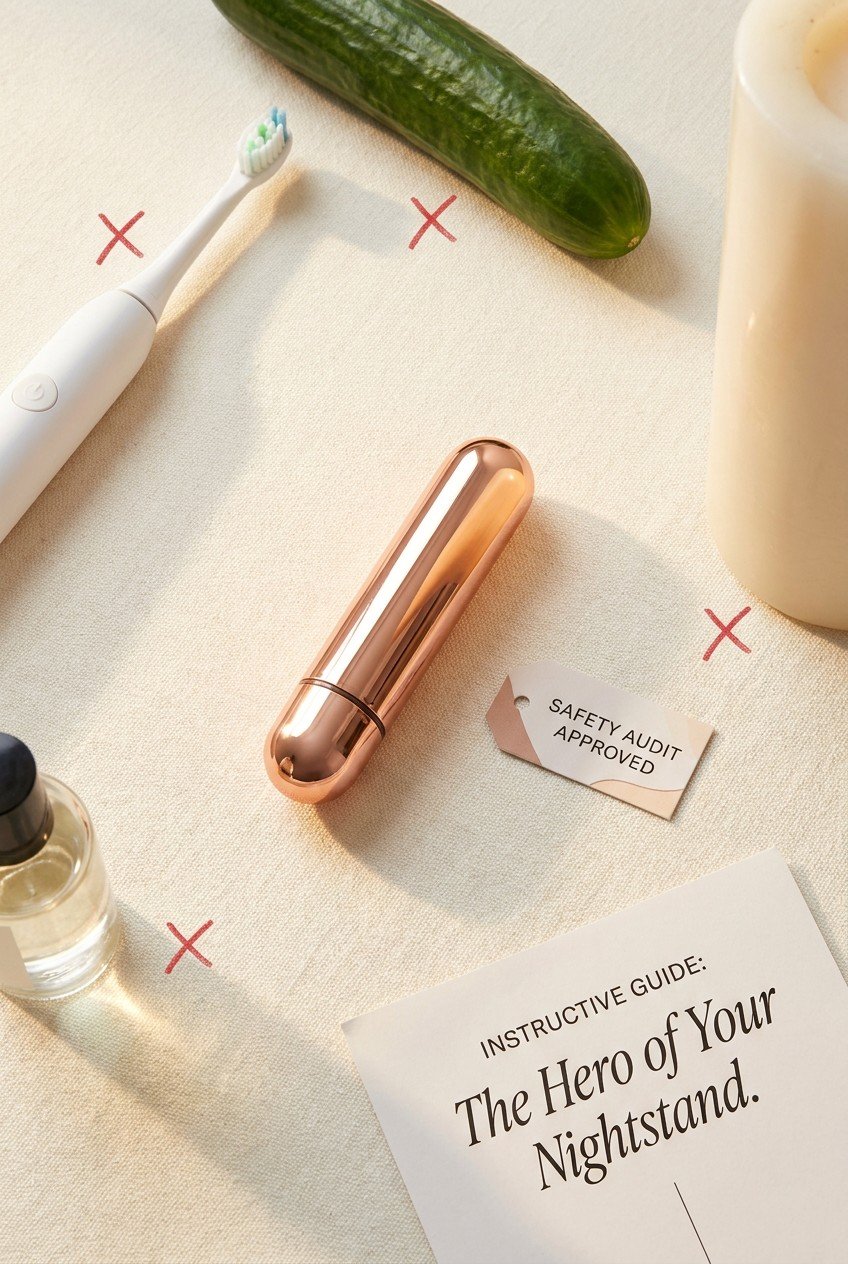



You spent $60 on a vibrator six months ago. It was great. Now the motor sounds like a dying refrigerator, the silicone has gone slightly sticky, and you’re wondering: Is this normal? Did I do something wrong?
Yes and yes. Most sex toys fail early — not because of manufacturing defects, but because people don’t know how to care for them. A well-maintained premium vibrator lasts 3–5 years. A neglected one dies in 6 months.
Here’s exactly how long each type of toy should last, what kills them early, and how to know when it’s time to let go.
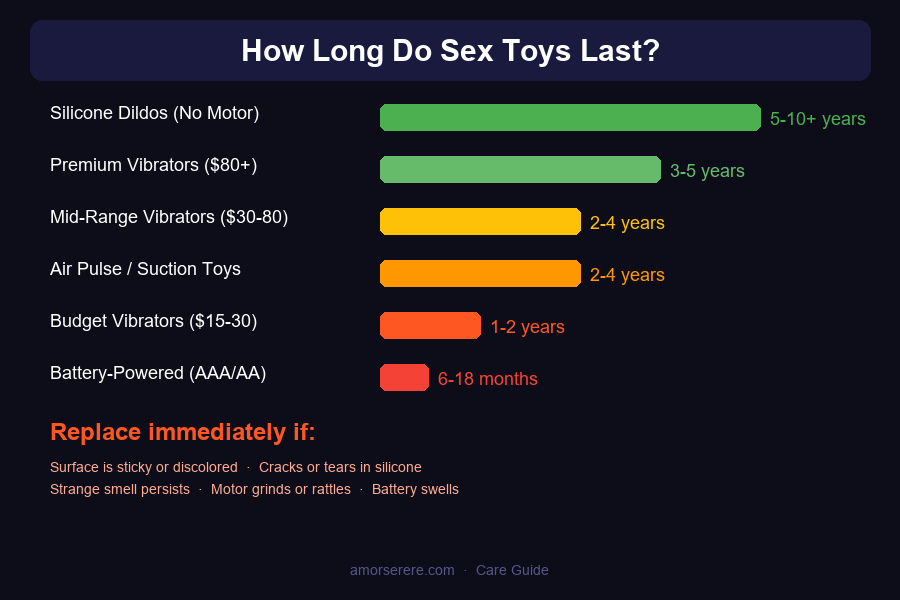
If there’s no motor, battery, or electronics, the only thing that can fail is the material. Medical-grade silicone — properly cared for — will outlast you. The silicone itself is chemically stable and non-porous.
The catch: silicone can degrade if stored incorrectly — touching other silicone toys, exposed to silicone-based lubricant, or left in direct sunlight. But with basic care (wash, dry, store separately), a high-quality silicone dildo is practically immortal.
This tier — brands that use medical-grade silicone, lithium-ion batteries, and sealed motor housings — is built to last. The motor is the limiting factor: even sealed bearings wear down over thousands of hours of use.
You can extend this to 5+ years if you:
The most common tier. Decent materials, solid motors, but cost-saving compromises:
Our Layla G-spot vibrator and Sona bullet fall in this range — both rated IPX7 waterproof with medical-grade silicone.
Rose toys have a unique failure mode: the diaphragm pump. Unlike a simple motor, the pump has moving parts that flex with every pulse. Over thousands of cycles, the diaphragm can stiffen or crack, reducing pressure.
The Rose Pro 3 is rated for approximately 200–300 hours of use before noticeable pressure loss — about 2–3 years at average usage.
At this price, you’re getting:
Budget toys aren’t evil. They’re the right choice if you’re testing whether you like a certain type before investing. Just don’t expect them to last, and replace them as soon as the surface texture changes.
The cheapest category, and the shortest lifespan:
If you use a battery toy, remove the batteries between uses. Storing it with batteries installed is the #1 cause of corrosion-related death.
“Waterproof” and “IPX7” are not permanent conditions. The seal around the charging port degrades with use. The #1 mistake: charging your toy immediately after washing it without thoroughly drying the port. A single drop of water in the charging contacts can short the battery.
How to prevent it: Always dry the charging port with a cloth or cotton swab before plugging in. If your toy has a magnetic charger, wipe both the contacts and the magnet.
Silicone lube chemically bonds with silicone toys. Over time, it causes the surface to become sticky, swollen, and eventually break down. The damage is permanent and unfixable.
The rule: silicone toys + water-based lube only. Always. This is the single most common cause of premature toy death, and it’s 100% preventable. Our materials guide has a deeper dive on safe lubricant pairings.
Lithium-ion batteries have a finite number of charge cycles (typically 300–500). Every time you drain to 0%, you burn through a cycle faster than if you charge at 20–30%.
The ideal habit: Charge when the battery indicator shows low (not dead), unplug when full, and don’t leave it on the charger overnight every night. One full discharge per month is fine for calibration — constant deep discharges are not.
Two silicone toys touching each other in a drawer = slow chemical reaction. The materials can fuse or degrade where they make contact. This is why high-end toys come with individual storage pouches.
How to do it right: Store each toy in its own cloth bag or dedicated compartment. No direct silicone-to-silicone contact. No plastic bags (they trap moisture). And for the love of god, not in the bathroom — humidity is the enemy of electronics.
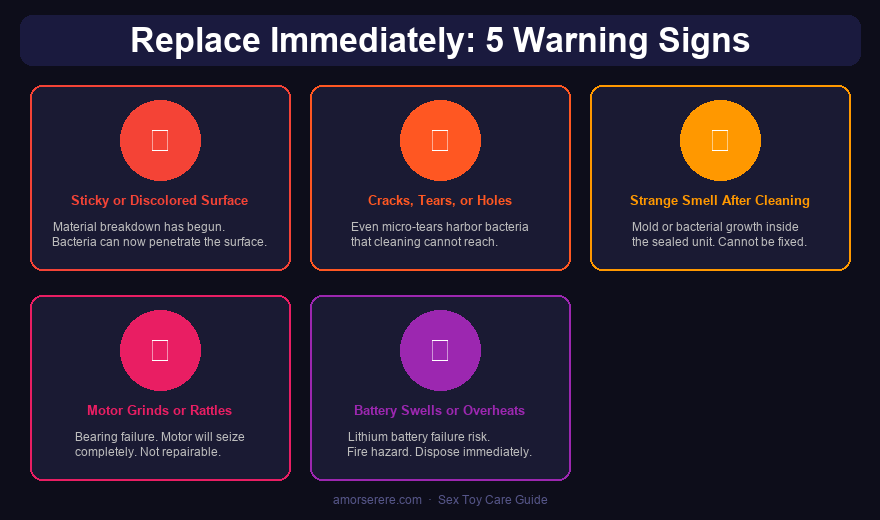
If you see any of these, throw the toy away. Not “use it one more time.” Not “maybe it’s fine.” Throw it away.
| Sign | What It Means | Action |
|---|---|---|
| Sticky or tacky surface | Silicone has begun chemically degrading. Pores are open, bacteria is present | Replace immediately |
| Cracks, tears, or holes | Even micro-fractures trap bacteria that soap cannot reach | Replace immediately |
| Strange smell (after cleaning) | Mold or bacterial growth inside sealed electronics | Replace immediately |
| Grinding, rattling motor | Bearing failure — motor will seize completely soon | Replace immediately |
| Swollen battery or overheating | Lithium battery failure — potential fire hazard | Stop using. Dispose at e-waste facility. |
These aren’t cosmetic issues. A compromised toy can cause irritation, infection, or — in the case of battery failure — actual injury. If you’re talking to a partner about toys, this is exactly the kind of safety conversation that builds trust.
Let’s do the real math, because “cheap” and “expensive” look different when you calculate cost over time:
| Toy Price | Expected Lifespan | Uses Per Week | Cost Per Use |
|---|---|---|---|
| $20 (budget) | 12 months | 2 | $0.19 |
| $60 (mid-range) | 48 months | 2 | $0.15 |
| $120 (premium) | 60 months | 2 | $0.23 |
The mid-range sweet spot is real: $60 spread over 4 years costs you less per use than a $20 toy that dies in a year. The premium tier costs more per use — but you’re paying for better materials, quieter motors, and a warranty.
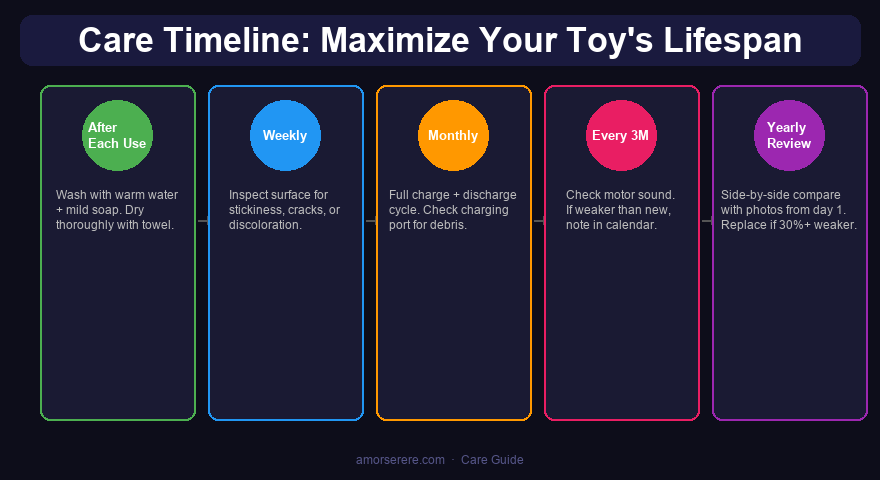
Here’s the routine that will get you the longest possible life from any toy:
After every use: Wash with warm water and mild, unscented soap. Dry thoroughly with a lint-free cloth. Charge only once the port is completely dry.
Weekly: Inspect the silicone surface under good light. Look for any change in texture, color, or the beginning of stickiness. Catch degradation early and you have time to order a replacement.
Monthly: Run one full charge-and-discharge cycle. Check the charging port for lint or debris — a wooden toothpick (never metal) can gently clear it.
Every 3 months: Listen to the motor. Is it louder than when you bought it? Does it sound different at specific speeds? This is your early warning system for bearing wear.
Yearly: Take a photo of your toy next to a ruler. Compare with a photo from day 1. Has the silicone shrunk? Swollen? Discolored? Memory is unreliable — photos aren’t.
Sex toys don’t have a printed expiration date, but every toy has a functional lifespan. Silicone dildos can last 5–10+ years with care; motorized toys typically last 2–5 years. Replace any toy the moment you notice surface changes, odors, or motor issues — regardless of age.
Almost never. Consumer vibrators are sealed units — the motor, battery, and circuit board are encased in silicone with no user-serviceable parts. The only fixable issue is a dirty charging port (clean gently with a dry cotton swab). Anything else means replacement.
No. Stickiness means the silicone molecular structure is breaking down. The surface is now micro-porous, trapping bacteria that cannot be cleaned. Continuing to use it risks irritation and infection. Replace immediately.
Remove the battery if possible. Take toys with lithium batteries to an e-waste recycling facility (Best Buy, municipal waste centers). Non-electronic silicone toys can go in regular trash. Do not put electronics in household garbage — lithium batteries are a fire hazard.
Sharing doesn’t affect mechanical lifespan, but it’s a hygiene concern — use a fresh condom on the toy between partners, clean thoroughly, and never share a toy with surface damage. For couples exploring together, read our complete guide to sex toys for couples.
A good toy should outlast a bad relationship. Treat it right, know when to let go, and don’t wait for warning signs to become emergencies.

Writer and relationship coach focused on intimacy, communication, and connection.