



Author: Dr. Yuki Tanaka Date: July 4, 2026 Reading Time: 13 minutes
If you found this page, you’ve already done the hardest part.
The second-hardest part was opening the search bar. The third-hardest was clicking the result that wasn’t porn. The rest, honestly, is just information—and information is the one thing that makes anal play go from intimidating to actually possible.
Here’s what nobody tells you at the beginning: you are not weird for being curious, you are not alone in being nervous, and you are definitely not the first person to type “is this normal” into Google at 1 AM. According to a 2018 study in the Journal of Sexual Medicine, roughly 30-40% of women and a similar share of men have tried anal stimulation at least once. That’s tens of millions of people in the US alone. You’re in a bigger club than you think.
This guide is different from most of what’s out there. I’m not going to tell you anal play is “mind-blowing” or describe it like a scene from a movie. I’m a sexual health educator. What I care about is safety, comfort, and giving you real information—so that if you decide to try this, you know exactly how to do it without hurting yourself.
And if you decide it’s not for you? Also completely fine. Knowing what you don’t want is just as valuable as knowing what you do.
Let’s start with the question you’ve probably had for a while but never asked out loud.
The answer isn’t psychological—it’s anatomical.
The anal canal and rectum are surrounded by a dense network of nerve endings. This is especially true near the opening, where the internal and external sphincters intersect. For men, the prostate gland (often called the P-spot) sits just a few centimeters inside the rectum, against the front wall. Stimulating it directly can produce orgasms that feel qualitatively different from penile-only orgasms—deeper, longer, and more full-body. For women, the nerve pathways around the anus, vagina, and clitoris overlap in the pelvic region. Stimulating one area can amplify sensation in the others. This isn’t esoteric—it’s basic pelvic floor anatomy.
Put simply: your body has pleasure sensors there. Not everyone’s are sensitive in the same way, and that’s fine. But the wiring exists in everyone.
One thing I need you to internalize: enjoying anal play says nothing about your character, your relationship, or your sexual identity. It doesn’t make you “kinkier” than someone who doesn’t. It doesn’t mean you’re gay if you’re a straight man who enjoys it. It doesn’t mean you’re submissive if you’re a woman who initiates it. Anal stimulation is a sensory preference—like enjoying back massages or being ticklish behind your knees. The only meaning it has is the meaning you assign to it.
This is where most guides fail. They jump from “it’s normal” straight to “here are products to buy.” The safety gap between those two sentences is where people get hurt.
The anal sphincter is a muscle designed to pull things inward. This is not a design flaw—it’s how your digestive system works. But it means that any toy inserted into the rectum without a wide, stable base will get pulled in entirely.
This is not a hypothetical. Emergency rooms remove objects from rectums every single day. Most of those objects were “improvised toys” or products without proper flared bases.
What to look for: A base that is noticeably wider than the widest point of the insertable portion. T-shaped bases are generally more comfortable and safer than round bases, which can slip past the sphincter if you’re using oil-based lubricant or during muscle relaxation.
What to avoid: Anything with a base the same width as the body of the toy. Bullet vibrators. Cylindrical objects of any kind with no base. “He said it would be fine.” None of these are fine.
If you remember nothing else from this entire article, remember this: no flared base = emergency room. Three syllables, easy to remember, impossible to forget.
The rectum does not self-lubricate. It wasn’t designed to receive objects, and it doesn’t produce moisture in response to arousal the way a vagina does. Without lubrication, even the softest silicone toy will cause micro-tears in the anal lining. Those tears hurt, and they also create pathways for bacteria.
Your choices:
Never use: Oil-based lubes with latex condoms. Oil degrades latex.
How much? More than you think. Not “a drop.” Not “a dime-size amount.” Coat the toy entirely, and apply a small amount externally as well. If at any point things feel “grippy” instead of smooth, stop and add more.
For a deeper dive on lube compatibility, see our Complete Lube Guide.
Your first anal toy should not impress anyone. It should be smaller than a finger. Size is not the goal—learning what the sensation feels like is the goal.
Recommended starting dimensions:
A small silicone butt plug with a slim taper fits these specs perfectly. So does a training kit with 2-3 graduated sizes.
The pacing rule: Before moving up one size increment (roughly 0.25 inches in diameter), you should feel fully comfortable at the current size across at least 3-5 sessions. Zero discomfort during insertion. Zero soreness afterward. Rushing this step is the single most common reason people try anal play once, have a bad experience, and never try again.
I need to be extremely clear about this because popular culture gets it catastrophically wrong.
Anal play should not hurt. It should not “burn a little at first.” It should not feel like something you need to “push through.” These are warning signs from your body, and they mean exactly what they say: stop, remove the toy, and reassess.
Pain during anal insertion usually means one of three things:
If you’re consistently feeling pain after addressing all three, your body might simply not enjoy this type of stimulation. That’s a valid answer. Stop. You don’t owe anyone a second attempt.
You don’t need a collection. You need one good starter toy that matches where you actually are, not where you want to be eventually.
Why it works: Tapered tip for easy insertion, flared base for safety, smooth surface minimizes friction, and the narrow neck lets your sphincter rest comfortably once the plug is in. You don’t need vibration for your first experience. You just need to learn what the sensation is.
What to look for:
Why not vibrating for the first time: Vibration adds sensation on top of sensation. When you’re still learning to interpret the basic feeling of fullness and pressure, layering vibration on top can be overwhelming. Start simple. Add vibration when you know your baseline.
Once you’ve used your plug comfortably a few times, beads offer a different sensation: the feeling of graduated widths moving in and out. The first bead is small, the last is slightly larger. This progression teaches your body to accommodate increasing widths naturally.
Again: flared base or retrieval ring on the last bead. No exceptions.
This isn’t a script for a perfect experience. It’s a protocol for a safe one. The difference matters.
Step 1: External awareness (2 minutes). Don’t touch the toy yet. Apply a small amount of lube to your finger and gently press the outside of the anus. Don’t insert. Just apply light pressure and notice the sensation. Breathe slowly. Exhale longer than you inhale—this physiologically triggers the parasympathetic nervous system, which controls muscle relaxation.
Step 2: Prep the toy (1 minute). Coat the entire insertable portion of the toy with lubricant. Not a thin film—a visible, generous layer. Apply a small additional amount to the anal opening.
Step 3: First insertion (the most important step). Position the tip of the toy against the opening. Apply gentle, steady pressure—not pushing, just pressing. Now wait. Your body will either tense up (stop, breathe, wait longer) or slowly relax and allow the tip to enter. This is the “letting the door open” feeling. You cannot force it. You can only invite it.
Step 4: Insert one-third to halfway. Do not insert the full length. Halfway is enough for your first experience. Once the widest part of the tip passes the sphincter, the muscle will close around the narrow neck. The plug should stay in place on its own.
Step 5: Stay still. Do nothing for 20-30 seconds. Notice what you feel. It might feel unfamiliar, slightly full, or barely noticeable. All of these are normal. The point is to let your brain register: I am safe. Nothing bad is happening.
Step 6: Gentle movement. If you’re using a plug, try clenching and releasing your pelvic floor muscles around it (Kegel movements). This subtle motion often produces the first moment of “oh, I see why people like this.” If you’re using a toy with your partner, let them hold it still first—no thrusting. Movement comes in later sessions.
Step 7: Removal. Gently and slowly pull the toy out as you exhale. Do not yank. If it feels stuck, it’s not—your muscles are just gripping. Breathe out, relax, and pull gently.
“Will anal play make me… loose?”
No. This is the most persistent myth in sexual health, and it needs to die.
The anal sphincter is a ring of muscle. Muscles don’t become permanently stretched from brief, gentle dilation—they return to their resting state. Chronic, forceful stretching over years can cause issues, but recreational use with appropriately sized toys does not. If this myth were true, everyone who’s ever had a large bowel movement would be incontinent. They’re not. You won’t be either.
“What if there’s… you know… residue?”
It happens. The rectum is not a sterile environment, and trace amounts of fecal matter are occasionally present even after using the bathroom. This is not a failure. It’s not disgusting. It’s a biological fact of using the part of your body that handles digestive waste.
Practical mitigation: go to the bathroom beforehand, wash externally with warm water, and put down a dark-colored towel. If there’s a small amount on the toy when you remove it, wash it off. That’s it. Don’t let the fear of a tiny, washable inconvenience prevent you from exploring something you’re curious about.
“Should I do an enema first?”
Not necessary for recreational anal play. Enemas wash out the natural mucus lining of the rectum, which provides lubrication and immune protection. Repeated enema use can disrupt gut flora and irritate the intestinal wall. A regular bowel movement, external washing, and a towel underneath you is sufficient.
“Can I use the same toy for anal and vaginal play?”
In the same session: absolutely not, unless you clean it thoroughly with soap and water between uses. Anal bacteria introduced to the vagina can cause bacterial vaginosis and urinary tract infections. Long-term: it’s safer to have dedicated anal toys and dedicated vaginal toys, labeled or stored separately. Silicone can be fully sterilized (boiling for 5-10 minutes), but material like TPE cannot.
“What if I try it and hate it?”
Then you tried something, learned you don’t like it, and can cross it off your mental list. That’s a successful experiment. You don’t owe anyone a second attempt, and you didn’t “fail” at anal play. You gathered data. That’s what mature adults do.
“Can I use household objects instead of buying a toy?”
No. I need you to read this next sentence carefully.
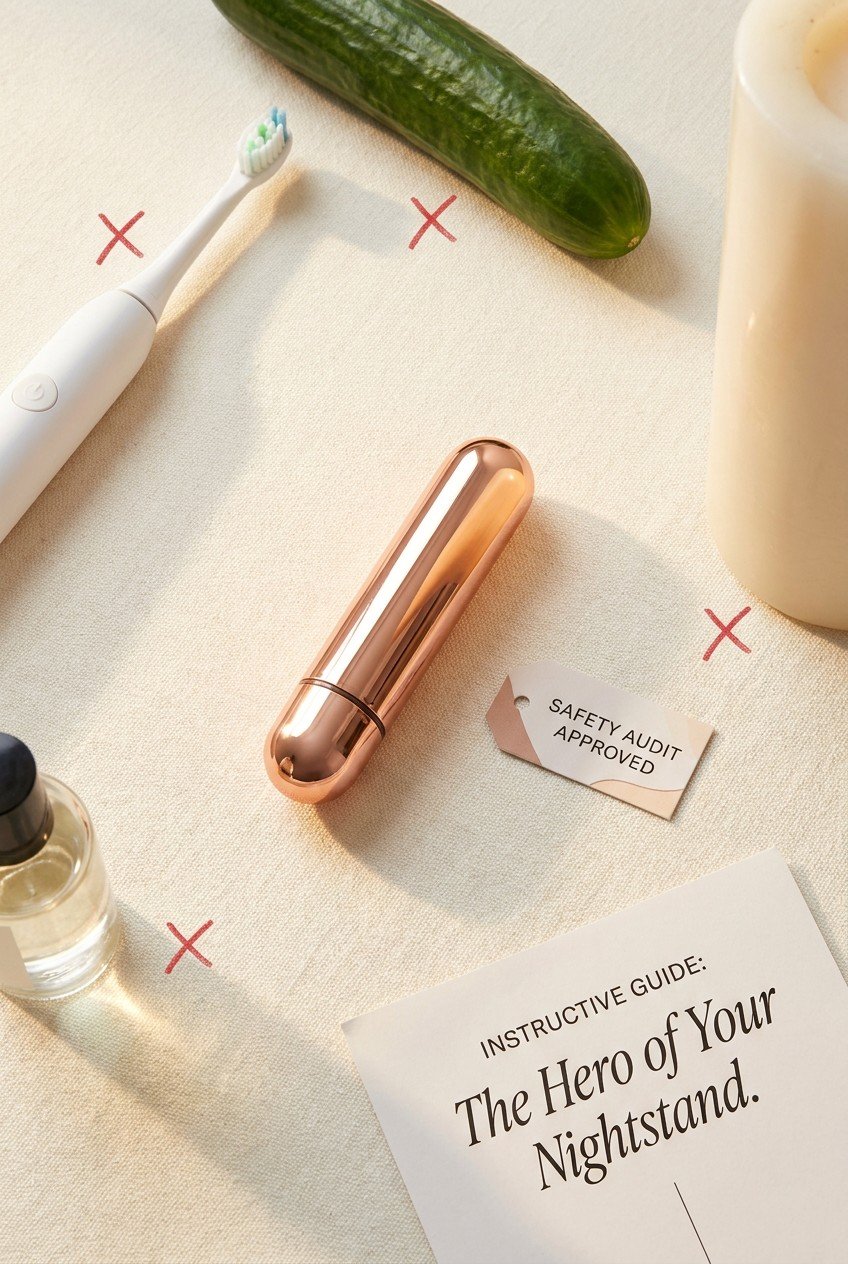
Vegetables break. Bottles have sharp rims. Hairbrush handles are porous and impossible to sanitize. Any object without a flared base will get lost. The $20-40 that a proper silicone toy costs is a rounding error compared to an emergency room bill, and infinitely cheaper than permanent injury. Do not improvise. Ever.
Here’s what the trajectory typically looks like for people who enjoy anal play:
Sessions 1-3: Same small plug, same slow insertion, same amount of lube. Focus on getting comfortable with the sensation. Some people feel ready for more by session 2. Most need 3-4 repetitions before it feels natural.
Sessions 4-6: Introduce gentle movement—slowly rotating the plug with your hand, or doing Kegel exercises around it. If you’re with a partner, they can now gently move the toy while you give feedback. Still the same plug. No size upgrades yet.
Sessions 7+: If you want to explore further, consider:
The rule at every stage remains the same: if it hurts, stop. Discomfort is data. Pain is a stop sign.
Here’s what I want you to take away from this—more than anything about flared bases or lubricant types or centimeter sizing.
Anal play is not a test. It’s not a “level” you need to unlock to be sexually experienced. It’s not proof of how open-minded you are, and skipping it is not proof of how inhibited you are.
It’s just one way your body can experience sensation. Some people love it. Some people try it once and shrug. Some people know without trying that it’s not for them. All three are correct answers.
If you decide to explore: do it safely, do it slowly, and do it because you are curious—not because you think it’s expected of you. That’s the only reason that holds up.
Ready to start safely? Browse our beginner-friendly anal toys—every product body-safe, every design with a proper flared base, every purchase private. No judgment. Just good information and better products.
About the Author:
Dr. Yuki Tanaka is a sexual health educator and pleasure researcher at AmorSerere. With a PhD in human sexuality and 8 years of clinical education experience, Dr. Tanaka writes about sexual wellness from a medically grounded, stigma-free perspective. Her work has been cited in peer-reviewed journals and mainstream publications. She believes good sex education is direct, evidence-based, and never makes you feel ashamed for asking questions.
Last Updated: July 3, 2026

Clinical sex educator with 10+ years experience. Specializes in body-safe materials and sexual wellness education.