




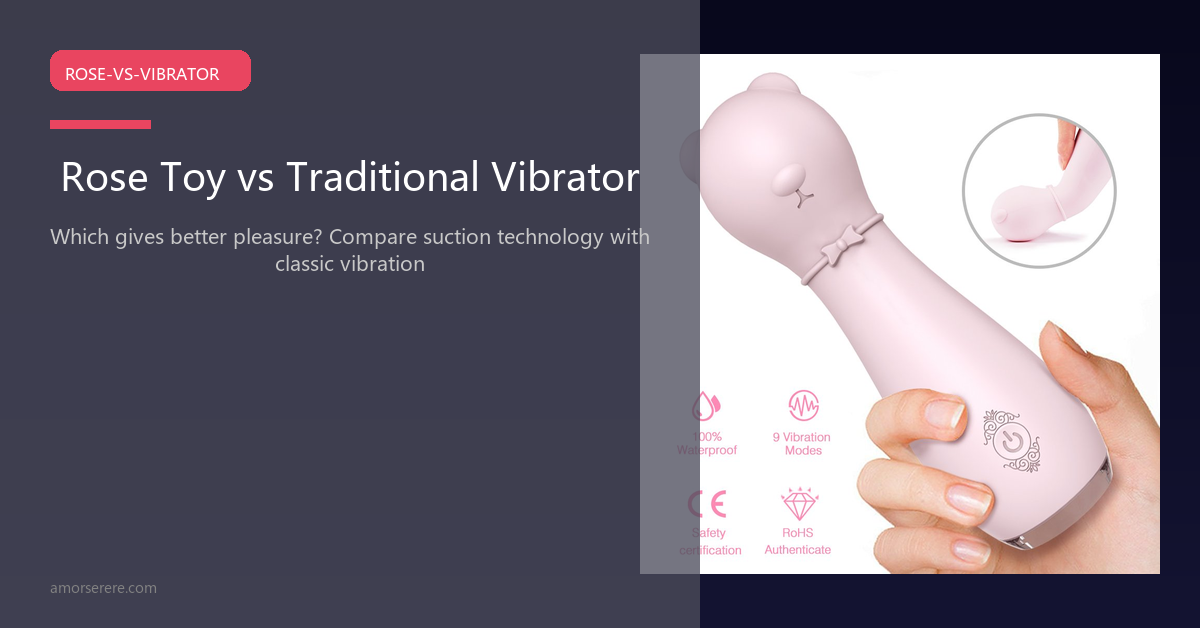
You’ve seen rose toys everywhere. TikTok. Instagram. Your group chat. That little silicone flower that looks like bathroom decor but has, frankly, no business being that effective.
And you probably already own a vibrator. Or you’re shopping for a first one. Either way, you’re stuck with the same question: Do I get the rose thing, or stick with a traditional vibrator?
The short answer: they’re not the same tool. Comparing them is like comparing a pressure washer to a garden hose — both move water, but the experience is completely different.
We’ve already covered rose toy vs wand vibrator and bullet vs G-spot. This one’s different: we’re comparing two fundamentally different technologies, not two shapes of the same motor.
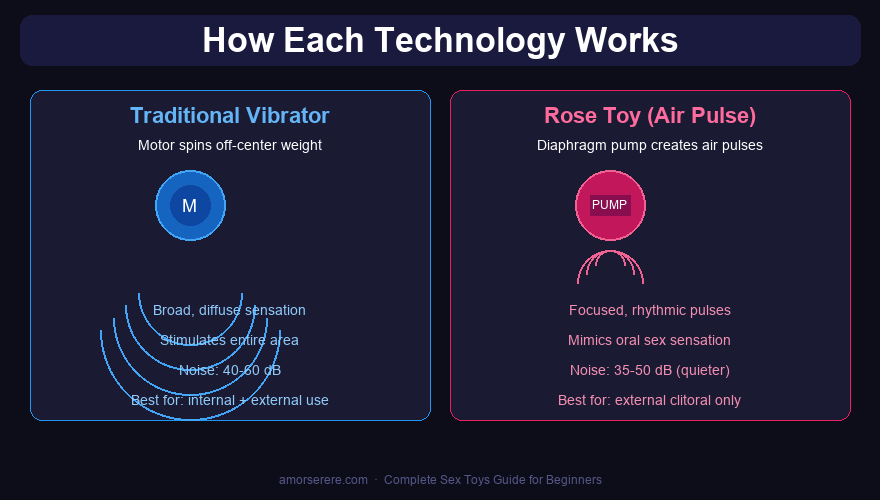
Every traditional vibrator — bullet, wand, G-spot, rabbit — uses the exact same mechanism: a small electric motor spinning an off-center weight. When the weight rotates, centrifugal force shakes the entire device.
That’s it. That’s the tech. Hitachi patented the Magic Wand in 1968, and the core mechanism hasn’t changed. It works. It’s reliable. But it has limitations: the vibration is broad and diffuse, meaning you feel it across a wide area, not a single precise point.
What this means in practice: a traditional vibrator stimulates everything in the general vicinity. That can feel amazing. It can also feel overwhelming, numbing, or imprecise.
Rose toys don’t vibrate. They use a diaphragm pump — the same mechanism as a blood pressure monitor — to create rapid pulses of air. A soft silicone nozzle fits around (not inside) your body, and the pump pushes and pulls air in rhythmic waves.
The sensation is completely different from vibration:
What this means in practice: a rose toy is a precision instrument designed for external clitoral stimulation only. You can’t use it internally. You can’t use it for massage. It does one thing, and it does it better than any vibrator.
Learn more about how body-safe silicone materials affect both technologies.
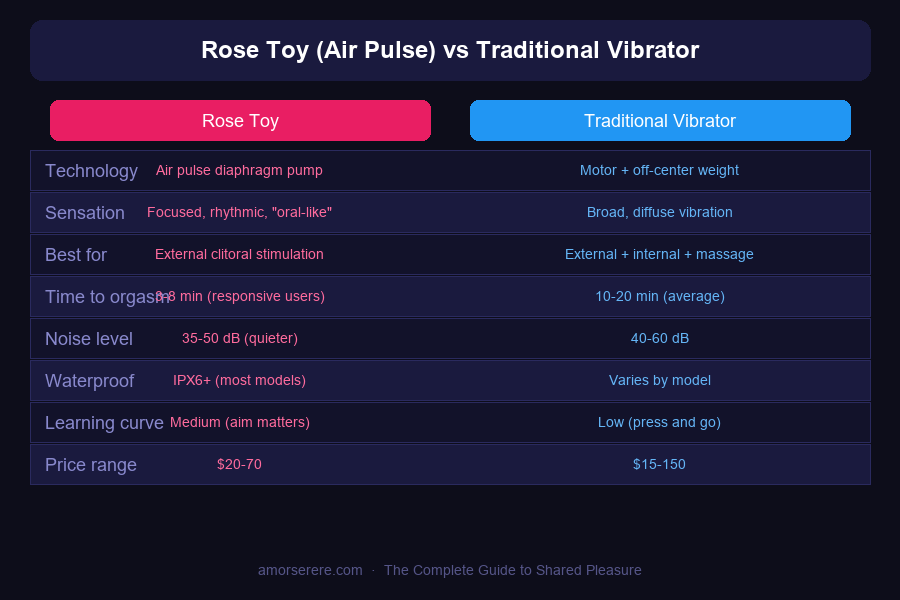
| Rose Toy (Air Pulse) | Traditional Vibrator | |
|---|---|---|
| Technology | Diaphragm air pump | Motor + off-center weight |
| Sensation | Pulsing, rhythmic, focused | Broad, diffuse, buzzing |
| Best For | External clitoral stimulation | External + internal + full body |
| Time to Orgasm | 3–8 min (responsive users) | 10–20 min (average) |
| Noise Level | 35–50 dB (quieter) | 40–60 dB |
| Waterproof | IPX6–IPX7 (most models) | Varies (check specs) |
| Learning Curve | Medium (aim matters) | Low (press and go) |
| Price Range | $20–70 | $15–150 |
| Internal use | ❌ No | ✅ Yes (G-spot/rabbit models) |
| Partner play during sex | ⚠️ Awkward shape | ✅ Pairs well |
You’ll prefer a traditional vibrator if:
You want internal stimulation. G-spot vibrators and rabbit toys reach places rose toys can’t. Our Layla G-spot vibrator is a classic example — curved, insertable, with both vibration and a telescopic motion.
You need versatility. A wand vibrator doubles as a body massager. A bullet travels well. You can use both alone or with a partner. Rose toys are one-trick ponies.
You’re sensitive to direct stimulation. Some people find air pulse too intense, especially at first. A gentle vibrator like the Sona bullet lets you start soft and build up.
You’re on a budget. Entry-level vibrators start at $15. The cheapest reliable rose toys start around $25–30. The gap isn’t huge, but it matters if every dollar counts.
You want something familiar. If this is your first toy — period — the learning curve on a rose toy might be frustrated. Start with what you know works. Our complete beginner’s guide walks you through first-time choices.
You’ll prefer a rose toy if:
You primarily orgasm from external stimulation. About 70–80% of people with vulvas need direct clitoral stimulation to orgasm. Rose toys are built for exactly this. No extraneous features. Just targeted, efficient stimulation.
You want speed. Air pulse tends to produce orgasm faster — studies and user reports consistently show shorter time-to-climax compared to vibration. At lower intensities it’s gentle; at higher, it’s almost overwhelming.
You hate the numbing buzz. Ever used a vibrator for 20 minutes and felt… nothing? That’s temporary nerve desensitization from constant vibration. Air pulse doesn’t cause it.
You need quiet. Rose toys run at 35–50 dB. That’s quieter than a refrigerator hum. Traditional vibrators start at ~45 dB and can reach conversation-level volume. If discretion matters, the rose wins.
You’re curious about “oral-like” sensation. The pulsing genuinely mimics a sensation that’s otherwise impossible to replicate with a motor. Our Rose Pro 3 is the classic entry point.
Here’s where the categories blur. Products like our Rose Pro 6 combine air pulse (the rose head) with a vibrating tail — two motors, two sensations, one device.
Pros:
Cons:
The hybrid is a great second toy. If you already know you enjoy vibration and want to try air pulse without committing to a separate device, it’s a smart bridge. But it’s not the best first choice — the complexity and price make it riskier.
This article is titled “Rose Toy vs Vibrator.” But let’s be honest: the comparison is a false dichotomy. They’re complementary tools, not competitors.
Most people who own both use them at different times: the vibrator when they want broad, gentle stimulation or internal exploration; the rose when they want focused, efficient, no-nonsense orgasm; both together when they’re in the mood for something intense.
If you can only buy one:
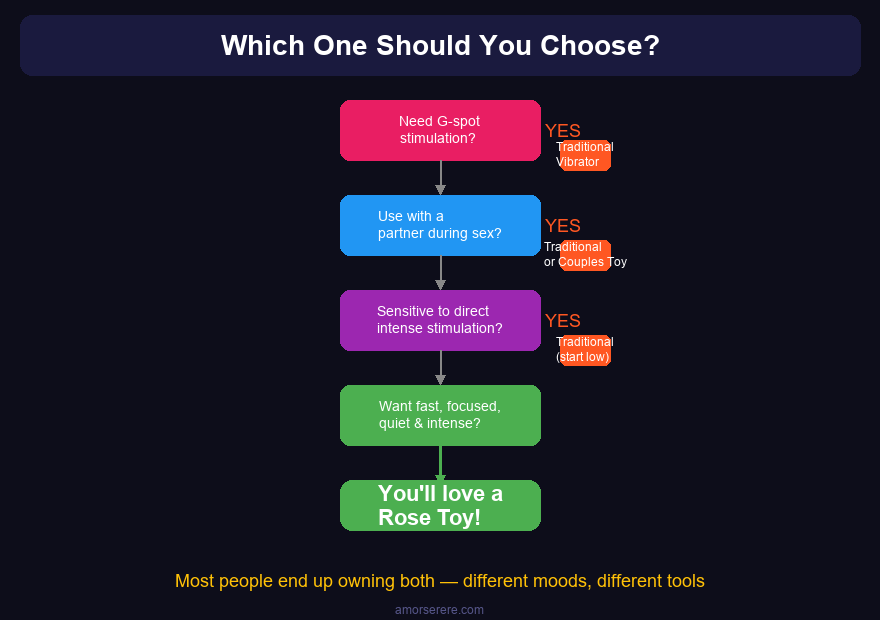
“Better” depends entirely on what you want. Rose toys are better at fast, focused, external stimulation. Vibrators are better at versatility, internal use, and partner play. Neither is objectively superior — they serve different purposes.
No. Rose toys are designed for external clitoral use only. The silicone nozzle creates a seal around external tissue; it cannot and should not be inserted. If you want internal stimulation, choose a G-spot vibrator or rabbit toy instead.
Rose toys are surprisingly quiet — typically 35–50 dB, which is quieter than most vibrators. At higher intensities the pump mechanism creates a soft rhythmic pulsing sound, but it’s unlikely to be heard through a closed door.
Both typically last 2–5 years with proper care on premium models. Motor-based vibrators can eventually develop bearing wear; rose toy diaphragm pumps can lose pressure over time. The biggest factor in longevity is proper cleaning and storage.
The Rose Pro 3 is a pure air pulse device — one function, expertly executed. The Rose Pro 6 adds a vibrating tail for dual stimulation. Choose the Pro 3 if you want the classic rose experience; choose the Pro 6 if you want both air pulse and vibration in one device.
Some people find air pulse overstimulating or just not their thing. That’s normal. Try lower settings first, use lubricant (it improves the seal), and give it 3–5 sessions before deciding. If it’s still not working, the sensation may simply not be for you — and that’s fine. Plenty of people prefer traditional vibration.
Ready to find your match? Browse our complete collection of vibrators and rose toys. Free discreet shipping on all orders.

Writer and relationship coach focused on intimacy, communication, and connection.