



I used to have a drawer. Inside that drawer were three vibrators, a bottle of lube, a tangle of charging cables, and a bullet vibrator I hadn’t seen in six months. Every time I opened it, the lube bottle was on its side, the cables had wrapped themselves around a wand like vines, and two silicone toys had fused together at the tips like they were trying to form a single mega-toy.
I dug through that drawer for ten minutes one night looking for the missing bullet, gave up, and spent the next day angrily buying storage solutions. I spent about $30 total. My drawer has not looked like a crime scene since.
This guide is what I learned — the material rules nobody tells you when you buy your first toy, the three storage setups that actually work, where to hide things so guests never find them, and why your silicone toys are eating each other right now if they’re touching.
This is the rule that taught me a $60 lesson. Different sex toy materials react with each other over time. Not immediately — you won’t see damage after a week. But after a month of two silicone toys pressed together in a drawer, the surfaces can permanently melt into each other.
Here’s the chemical reality:
Silicone + Silicone = Melt. Medical-grade silicone is chemically stable on its own, but prolonged contact between two silicone surfaces allows polymer chains to interdiffuse. The result: two toys that were separate are now permanently bonded at the contact point. You can try to pull them apart. You might succeed. But both surfaces will be scarred, and the damaged silicone is now a bacteria trap.
TPE + TPE = Worse. TPE (thermoplastic elastomer) contains plasticizers — chemical softeners that keep the material flexible. When two TPE toys touch, their plasticizers migrate between surfaces, accelerating breakdown. After enough contact time, you’ll open your drawer to find a single mass of goo. Not salvageable.
Silicone + TPE = Damage to the Silicone. TPE plasticizers leach into silicone, making it sticky and cloudy. The silicone absorbs the chemicals. You can’t clean this off. The toy is ruined.
Glass + Anything = Safe. Glass is chemically inert. It doesn’t react with silicone, TPE, metal, or anything else. A glass toy can sit next to any other toy forever without damage.
Metal + Silicone = Safe, but Watch the Edges. Metal doesn’t react with silicone chemically, but metal edges — especially on cheaper toys where seams weren’t polished smooth — can scratch silicone surfaces. Wrap metal toys in their own cloth pouch.
ABS Plastic + Anything = Safe. Hard ABS plastic (the rigid core inside many vibrators and the body of most bullets) is chemically stable and won’t react with any toy material.
The bottom line: Every toy needs its own separate storage compartment, pouch, or divider. No exceptions. This is not optional for anyone with more than one toy. For a complete breakdown of which materials are safe for which types of contact, see our body-safe materials guide.
Every bottle of lubricant in your drawer needs to be standing straight up with the cap screwed tight. Here’s why:
Water-based lube on its side: The liquid slowly seeps around the cap threads. Over days, a thin film of lube spreads across whatever it’s touching. Water-based lube evaporates, leaving behind a glycerin or cellulose residue that’s sticky and attracts dust. Worse, that residue is a food source for bacteria.
Silicone-based lube on its side: This is the expensive mistake. Silicone lube leaking onto a silicone toy degrades the toy’s surface. The silicone molecules in the lube bond with the silicone in the toy, creating a permanent sticky layer that no amount of cleaning removes. I lost a $50 bullet vibrator to a tipped bottle of silicone lube. Learn from my drawer. (Not sure which lube is right for your toys? Our complete lube guide covers compatibility with every material.)
The fix: Store lube bottles upright in a cup, a dedicated slot in your organizer, or simply standing against the side of the drawer. If the bottle has leaked at all, wipe the threads clean before recapping.
Moisture + dark enclosed space = mold, starting within 24 hours. This is not a cosmetic problem. A moldy toy goes in the trash.
Silicone toys: The surface doesn’t absorb water, but every seam does. The junction where the shaft meets the handle. The groove around control buttons. The base of any ridges or texture features. After washing, shake out all visible water, then air-dry for at least 30 minutes. Better: dry with a microfiber cloth first, then air-dry. (For the complete cleaning routine that precedes storage, follow our step-by-step vibrator cleaning guide.)
TPE toys: TPE absorbs water into its pores. Surface-dry is not dry. A TPE toy needs at least an hour of open-air drying before storage, preferably with a fan or in a well-ventilated spot. TPE stored damp will grow mold inside the material — invisible at first, then suddenly the toy smells bad and can’t be saved.
Motorized toys: The motor housing has ventilation holes — needed for heat dissipation. Those same holes collect water during washing. After cleaning a motorized toy, hold it handle-up and gently shake, motor-end down, to drain any water that collected near the motor. This is the most commonly overlooked drying step for vibrators.
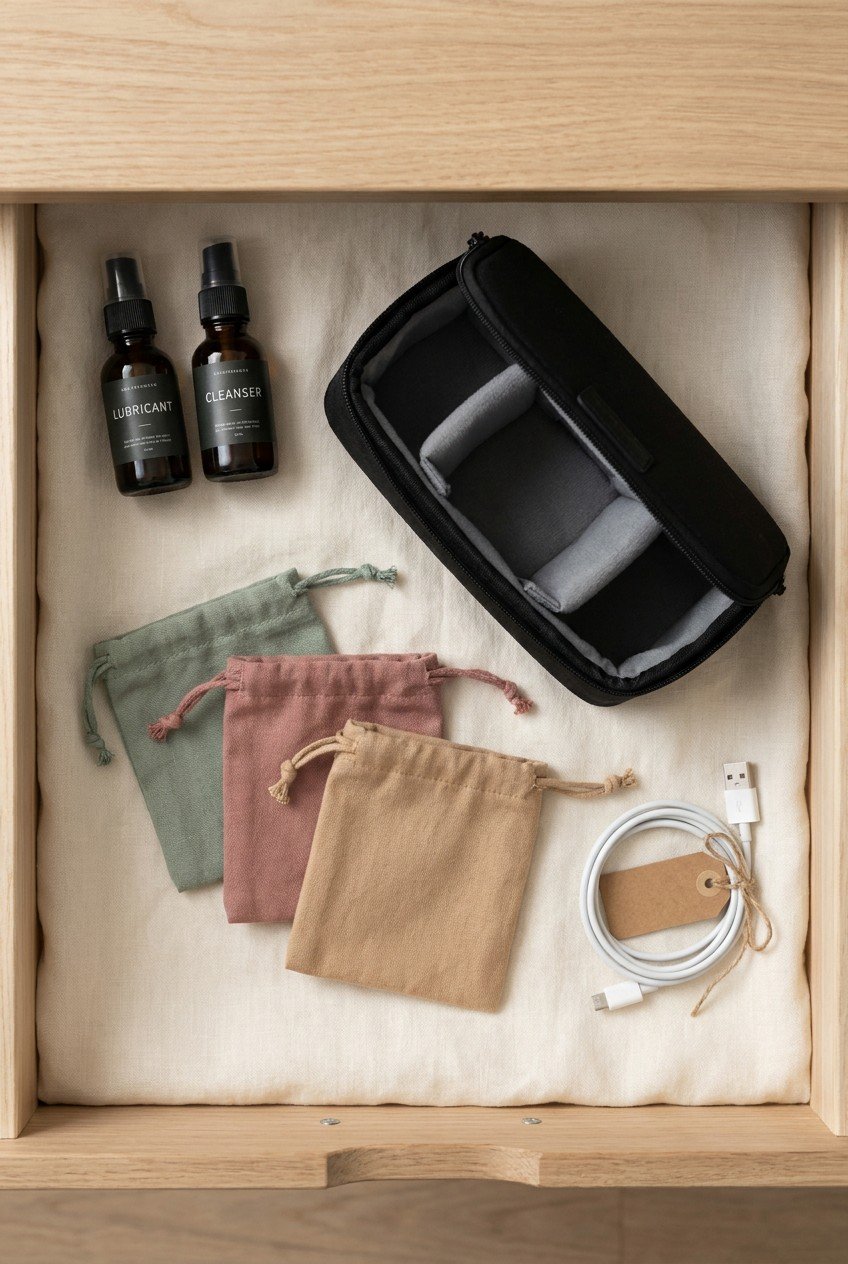
This is the cheapest, most flexible solution. Buy a set of cotton or microfiber drawstring pouches — one per toy. Each toy lives in its own pouch. All pouches go into a drawer or box.
What to buy: 100% cotton drawstring bags, available in bulk online for about $1–2 each. Look for unbleached cotton — no dyes that could transfer to your toys. Microfiber pouches work too and are slightly better at wicking moisture, but cotton is fine for fully dry toys.
Do NOT use: Plastic Ziploc bags for long-term storage. They don’t breathe. Any residual moisture gets trapped. Plastic bags are for airport security, not for your drawer.
Best for: 2–5 toys, people who live alone or with a partner who already knows about the toys, anyone on a tight budget.
The system: Label each pouch if you have multiples of the same type. A small tag or different-colored drawstrings solve the “which pouch has the rabbit and which has the wand” problem.
A hard case with adjustable dividers — each toy gets its own compartment, no pouches needed, everything visible at a glance.
What to buy: A camera lens case with adjustable velcro dividers. These are purpose-built to protect irregularly shaped objects and are almost comically perfect for sex toys. They’re padded, dust-proof, and look completely innocent in a closet. Search for “camera lens divider case” or “adjustable storage case” — the interior dimensions should be at least 12 × 8 × 4 inches to fit most vibrators.
Alternatively, a jewelry organizer with large compartments works for bullets, finger vibrators, and small toys.
Best for: 5–10 toys, people who want to see everything at once without opening pouches, anyone who appreciates tidiness.
The system: Assign compartments by type — one section for bullets, one for vibrators, one for accessories like rings and plugs. Velcro dividers let you resize compartments when you add or remove toys. Keep the lube bottle upright in a corner compartment.
The nuclear option. A hard case with a combination or key lock that looks like a makeup case, tool case, or document box from the outside.
What to buy: A lockable aluminum cosmetics case, a lockable tool case, or a dedicated sex toy storage case (several brands now make purpose-built ones). The key feature is the lock — not to prevent theft, but to prevent casual discovery by roommates, children, parents, or the friend who needs to borrow a phone charger and opens the wrong drawer.
Best for: Anyone who shares living space with people who shouldn’t find their toy collection. Parents. Roommates. Frequent guests.
The system: Case goes under the bed, on the top shelf of the closet, or in the back of a storage area. Add a small silica gel packet (the “do not eat” packets that come with shoes and electronics) to absorb ambient moisture. Replace the packet every 3–6 months.
| Your Situation | Best Setup |
|---|---|
| 2–5 toys, live alone | Individual cloth pouches in a drawer |
| 5–10 toys, want visible access | Divided organizer box in the closet |
| Roommates, kids, or frequent guests | Lockable storage case in an out-of-sight location |
| Travel frequently | Pouch system + a small organizer for your go-bag |
A lock solves most problems. But if you’re not ready to lock up your drawer, placement matters.
A locked suitcase in the top of your closet. Nobody opens a locked suitcase in someone else’s house. This is the gold standard. Put your organizer box inside the suitcase, lock the suitcase, push it to the back of the top shelf.
A lockable storage case under the bed, pushed deep toward the headboard. Under-bed storage is invisible unless someone crawls on the floor. Guests don’t crawl on floors. The lock handles the edge case.
Inside a piece of furniture with a hidden compartment. If you have an ottoman with interior storage, a bed frame with under-mattress drawers, or anything that requires knowing it’s there to find it — you’re gold.
Top shelf of the closet, inside a shoebox labeled “Winter Scarves.” The combination of height (guests don’t look up), closed box (curiosity requires extra effort), and boring label (nobody cares about scarves) makes this surprisingly effective.
Deepest drawer of a dresser, inside an opaque organizer box, under a layer of old t-shirts. Multiple barriers. Most people opening a drawer glance at the top layer and close it. They don’t excavate.
Nightstand top drawer. This is the first drawer anyone opens when they need a pen, a phone charger, or a tissue. It’s the least private drawer in your entire home.
Under your pillow. Housekeeping, partners changing the sheets, a friend sitting on your bed and leaning back — pillows get moved constantly. This is not hiding. This is displaying with extra steps.
Bathroom cabinet. Humidity from showers degrades toys and materials. Guests use your bathroom, open your cabinet for toilet paper or a towel, and find your collection. Double failure.
Under the mattress. Mattresses get lifted for cleaning, sheet changes, and moving. Anything under a mattress will be found. Also, body weight compresses mattress storage, and that compression force can damage toy motors and silicone over time.
The principle: The best hiding spot is boring, locked, and not in anyone’s natural path. Nobody opens a toolbox in your hall closet. Nobody reads the label on a shoebox on the top shelf. Make your storage uninteresting, and it disappears.
Charging cables are the socks of sex toys — they multiply, tangle, and disappear when you need them.
Every 3–4 months, open every pouch and every compartment. Check for:
Once a year, replace all silica gel packets in your storage case. Wash all cloth pouches (gentle cycle, air dry — no fabric softener, which leaves residue). Re-label anything whose label has worn off. Toss the cable for any toy you no longer own.
My old drawer was chaos. The lube bottle was permanently horizontal. Two silicone toys had fused at the tips in a way I will never fully explain to myself. Charging cables coiled around everything like predatory snakes.
That drawer is now a Japanese organizer’s Instagram. Three 4pouches.One20 camera case. All the lube bottles standing upright. Zero toys touching. I know where my bullet is every time I want it.
You don’t need a 100storagesystem.Youneedthethreeironrules(separateyourmaterials,standyourlubeup,dryeverythingcompletely),oneofthethreesetupsthatmatchesyourlife,andahidingspotthat′sboringinsteadofclever.That′sit.Oneafternoon.10–30. A drawer you won’t be embarrassed to open.
Your toys last longer when they’re stored right. Your cleaning routine actually works when dry toys go into clean storage instead of a damp drawer. And you’ll never spend ten minutes digging for a bullet vibrator that turned out to be wedged behind a lube bottle the entire time.
What I actually bought, for reference: 6-pack of cotton drawstring bags (8),oneadjustablecameralenscase(22), total $30. Everything fits. Nothing touches. It’s been two years and not a single melted toy.
Ready to organize? Browse our toy care essentials — including storage pouches, cleaning wipes, and travel cases.
About the Author:
Maya Chen is a product reviewer and real-life tester at AmorSerere. She learned about silicone-on-silicone melting the expensive way — by pulling two fused vibrators out of a drawer in 2024. Every storage tip in this guide was earned through personal failure. She now owns labeled pouches, a camera case full of vibrators, and a deep suspicion of loose charging cables.
Last Updated: July 10, 2026

Real-world product reviewer and sexual wellness advocate. Tests every toy personally so you don’t have to guess