Introduction
The first time I needed a vibrator and didn’t have one, I was 19 and living in a dorm with paper-thin walls. The campus bookstore did not stock the Rabbit. Amazon deliveries went through the mailroom, where a senior named Greg opened every package. I had an electric toothbrush, a detachable shower head, and a biology textbook.
I chose the shower head. It worked. What I didn’t know — what nobody told me — was that the hot water I’d cranked to maximum was giving me a minor chemical irritation that I’d feel for the next two days, and that the removable head, which I’d removed, had exposed a metal threading that could have cut me if I’d angled it wrong. I got lucky. Not everyone does.
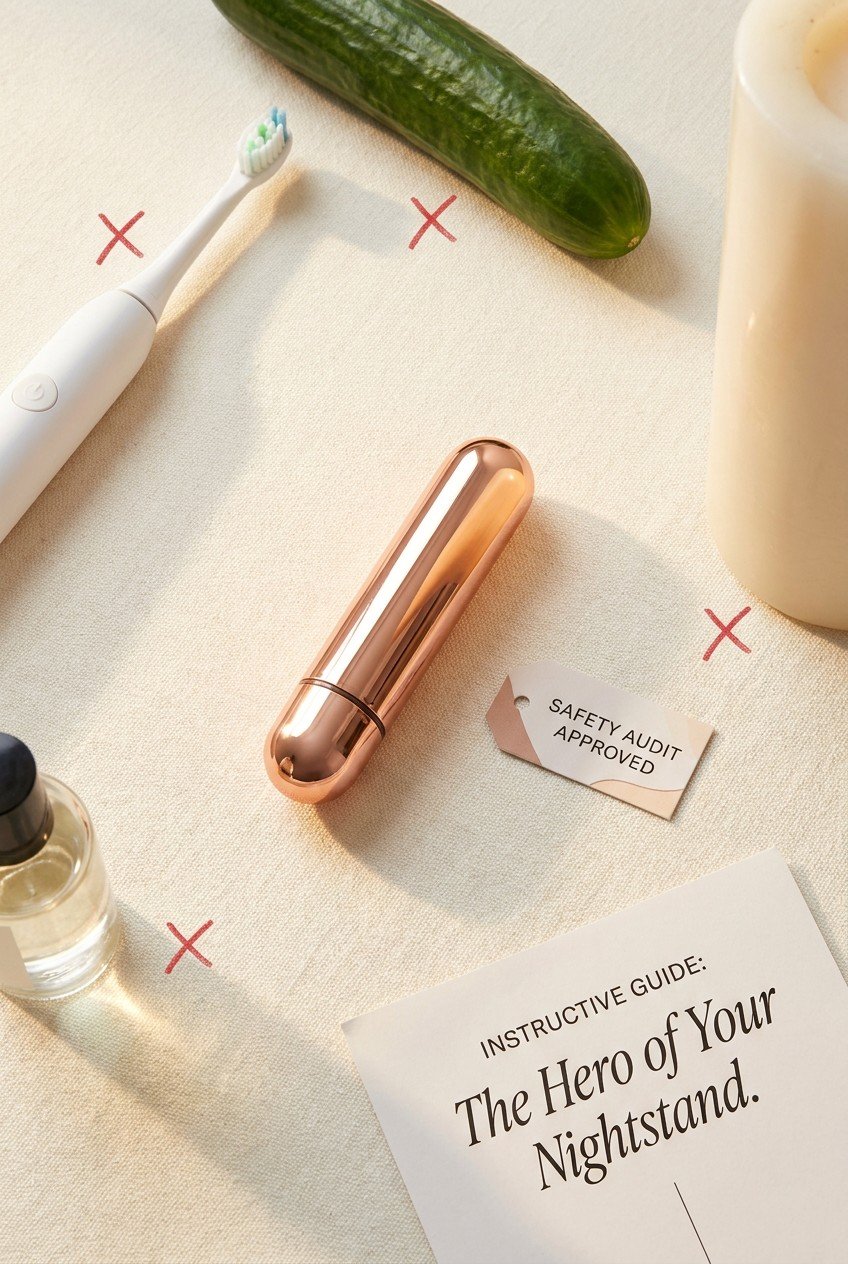
This is the article I needed at 19. A safety audit of every improvised masturbation method — the ones that are basically fine, the ones that need precautions, the ones that are dangerous but fixable, and the ones that should never go anywhere near your genitals. It’s not judgment. It’s harm reduction. People have been getting off with household objects since the invention of the household. This is about doing it without an ER trip.
Part 1: Why Use “Real” Toys? Because an ER Doctor Has Seen Your Cucumber
Before the audit: a word of advocacy for actual sex toys.
Sex toys exist because the human body has specific needs — vibration frequency, material safety, shape ergonomics — that household objects were not designed to meet. A $30 silicone vibrator is cheaper than an ER copay. It’s designed to be insertable, non-porous, waterproof, and shaped not to get stuck. Your electric toothbrush is designed to clean teeth.
The best argument for buying a real toy is not morality. It’s physics. Vibrators vibrate faster. Silicone doesn’t harbor bacteria. Flared bases prevent hospital visits. If you’ve been improvising for years and everything’s been fine: great. You’re playing with house money. The audit below tells you what the house edge is.
Browse our beginner-friendly selection — everything ships in plain packaging, and no senior named Greg will open it: shop all vibrators.
Part 2: The Safety Tier List
🟢 Tier 1: Basically Fine (With Basic Precautions)
Detachable Shower Head
Method: Directing the water stream at the clitoris or vulva. The most classic of non-toy methods.
Safety rating: 🟢 Low risk with precautions.
What could go wrong:
- Hot water irritation: The vulvar tissue is thin and vascular. Water that feels warm on your hand is hot on your clitoris. Chemical irritation, micro-burns, and tissue inflammation from prolonged hot water exposure are common and uncomfortable.
- High-pressure damage: Some shower heads produce water pressure sufficient to force water into the vaginal canal or urethra. Water forced into the vagina disrupts the natural flora (bacterial vaginosis). Water forced into the urethra can cause urinary tract infections.
- Exposed metal threading: If you remove the shower head entirely, the pipe threading is sharp. A slip means a cut on your labia. Do not Google “labia laceration from shower pipe.” Just trust me.
- Water temperature fluctuations: Someone flushes a toilet elsewhere in the building → your gentle warm stream becomes scalding. Showers in shared plumbing systems are not temperature-stable.
How to do it safely:
- Temperature check on your inner wrist, not your hand. Wrist skin is closer to vulvar sensitivity.
- Keep the shower head attached. The stream through the head is diffused. The pipe underneath is not.
- Use the lowest pressure setting. You don’t need a power washer.
- Do not aim the stream directly into the vaginal canal. External stimulation only.
- Limit sessions to 10–15 minutes. Prolonged hot water exposure irritates.
Verdict: The safest improvised method on this list. Do it right and the only side effect is a high water bill.
Pillow / Stuffed Animal Humping
Method: Straddling and rubbing against a pillow, stuffed animal, or bundled blanket.
Safety rating: 🟢 Zero physical risk.
What could go wrong:
- Fabric friction: prolonged rubbing against rough fabric can cause skin irritation. Cotton pillowcases are fine. Burlap is not.
- Laundry: you will need to wash the pillowcase. A lot.
How to do it safely:
- Use a clean pillowcase. Change it regularly.
- Place a towel between you and the pillow for easier cleanup.
- If using lotion or lubricant, water-based only — oil-based products stain fabric and don’t wash out.
Verdict: The most underrated method. Zero insertion risk. Zero cost. Zero noise. Fully clothed if needed. This is the Toyota Corolla of masturbation — boring, reliable, and will never strand you on the side of the road.
Handheld Massager (Wahl / Hitachi-Style Body Wand)
Method: Using a plug-in body massager — originally designed for back and neck muscles — on external genitals.
Safety rating: 🟢 Low risk with precautions.
What could go wrong:
- Overstimulation numbness: Body massagers are more powerful than most purpose-built vibrators. Extended use on one spot can cause temporary nerve desensitization — the area goes numb for hours. It’s temporary but alarming.
- Electrical hazard: Plug-in massagers near water are a shock risk. No body massager in the bathtub. Ever.
- Heat buildup: Motorized massagers heat up during extended use. The surface can become uncomfortably warm after 10+ minutes.
How to do it safely:
- Keep sessions short — 10–15 minutes. The power is the point, but the numbness is real.
- Never use near water. Not “away from the tub.” On a different floor from the tub.
- Place a thin cloth (clean T-shirt, thin towel) between the massager and your skin. This diffuses the vibration and prevents the “too intense” sensation some people find overwhelming.
- If the massager has multiple heads/attachments: use a smooth, flat head. Not the knobby one. Not the “deep tissue” one.
Verdict: The Hitachi Magic Wand started as a body massager and became the most famous vibrator of all time. The line between “body massager” and “vibrator” is marketing, not engineering. If you own one for your back, you own a vibrator.
Fingers (Your Own or Someone Else’s)
Method: Self-explanatory.
Safety rating: 🟢 Zero physical risk with clean hands and trimmed nails.
What could go wrong:
- Dirty hands + vaginal insertion = bacterial vaginosis, yeast infection, UTI.
- Long or sharp fingernails + internal stimulation = micro-tears in vaginal or rectal tissue.
- Hand lotion or hand sanitizer residue = chemical irritation on mucous membranes.
How to do it safely:
- Wash hands before. Not “rinsed.” Washed with soap.
- Trim and file nails. The sharp edge you can’t feel on your thumb is very feelable inside your vagina.
- Use lubricant. Fingers are not self-lubricating. Your hand absorbs natural moisture.
- No hand lotion or sanitizer within 30 minutes of masturbation. Residue remains.
Verdict: The only method that’s 100% designed for genitals. Your fingers have been doing this longer than any vibrator. Don’t overthink it.
🟡 Tier 2: Needs Serious Precautions
Electric Toothbrush
Method: Using the vibrating handle or head of an electric toothbrush for external stimulation.
Safety rating: 🟡 Moderate risk — doable but requires thinking.
What could go wrong:
- Bristle damage: Even a retired toothbrush head has bristles. Bristles on clitoral tissue cause micro-abrasions. The bristles harbor bacteria from their previous career cleaning teeth. Oral bacteria + genitals = infection.
- Sharp plastic edges: The seam where the head connects to the body, the battery compartment seam — cheap toothbrushes have mold edges that scrape.
- Weak vibration: Electric toothbrushes vibrate at much lower amplitude than purpose-built vibrators. You may find it ineffective, which leads to pressing harder, which leads to bruising.
- Battery compartment: If you’re using the handle end (non-bristle) and the battery compartment pops open during use — batteries and genitals should not meet.
How to do it safely:
- Use only the handle — the smooth end, not the brush head. Never use the bristle end. Not even with a “clean” head. The bristles are never clean enough for this.
- Use a toothbrush dedicated to this purpose. Not “the one I clean my teeth with and also.” Buy a $10 electric toothbrush and designate it. Write “NOT FOR TEETH” on it if you have roommates.
- Cover the handle with a condom. This provides a smooth, clean surface and eliminates the battery-compartment-pop-open hazard.
- Keep sessions short. The vibration is weak — pressing harder to compensate is the most common injury mechanism.
Verdict: The most common improvised vibrator. Better than nothing. Worse than a $20 bullet vibrator that’s actually designed for this. If you’re reading this article, go buy the bullet. You’ll spend more on replacement toothbrush heads than on a real vibrator.
Food Items (Cucumbers, Bananas, Carrots, etc.)
Method: Inserting phallic-shaped produce.
Safety rating: 🟡 High risk — do at your own extremely informed peril.
What could go wrong:
- No flared base: Produce has no base. The anal sphincter and vaginal muscles can draw objects inward. A cucumber without a flared base can migrate past the anal sphincter and become irretrievable without medical intervention. This is a known ER presentation. The ER doctor has seen this. Many times.
- Bacterial contamination: Produce carries soil bacteria. The vaginal ecosystem does not appreciate soil bacteria. Infection.
- Pesticide residue: Non-organic produce has surface pesticides. The vaginal mucosa absorbs chemicals directly into the bloodstream.
- Breakage: Produce breaks under pressure. A piece of broken cucumber inside the rectum or vagina is not easy to retrieve.
- Surface texture: A carrot is not smooth. The ridges and bumps are abrasion risks.
- Temperature: Cold produce straight from the fridge causes muscle spasm in the vaginal canal or rectum. Not pleasant. Not safe.
How to do it safely (if you must):
- Use a condom over the item. This is non-negotiable. The condom provides a smooth surface, a bacterial barrier, and — critically — something to hold onto for retrieval. Hold the condom’s rolled edge outside the body.
- Wash the produce thoroughly with soap and water before covering with the condom. This reduces (but does not eliminate) pesticide and bacteria risk.
- Never insert produce anally. The lack of a flared base makes this a one-way trip. The ER is not a fun trip.
- Never insert anything that can break: bananas overripe, cucumbers with cracks, any produce that’s been in the fridge for a week.
- Use lubricant. Produce skin is not lubricated. Friction = micro-tears.
Verdict: I’m not here to shame you. I’m here to tell you that a $15 silicone dildo with a flared base is cheaper than an ER copay, safer for your body, and won’t snap in half inside you. The produce section is not a sex shop. Buy the dildo.
Candle (Unlit)
Method: Inserting a smooth, unlit candle.
Safety rating: 🟡 Moderate risk — fixable with the right precautions.
What could go wrong:
- Breakage: Candles are not designed for internal pressure. Wax is brittle. A broken piece of wax inside the rectum or vagina requires retrieval.
- Scented candles: Fragrance oils are chemical irritants on mucous membranes. The “vanilla bean” scent is nice in your living room. Inside your vagina, it’s chemical vaginitis.
- Colored candles: Dyes are not body-safe. The coloring that makes a candle “ocean blue” is not FDA-approved for mucosal contact.
- Paraffin wax: Petroleum-derived paraffin is not body-safe for internal use. It can contain trace carcinogens.
- No base: As with produce: no flared base, no anal use. Period.
How to do it safely (if you must):
- Unscented, uncolored, 100% soy or beeswax candle only. Not paraffin. Not “aromatherapy blend.”
- Cover with a condom. This is non-negotiable for the same reasons as produce.
- Never insert anally. No base = no.
- Inspect for cracks before use. A flawed candle breaks under pressure.
- Do not use a candle you later plan to burn. “Clean” is a relative term.
Verdict: Soy massage candles — the kind designed specifically for skin use that melt into warm oil — are the only “candles” that belong in this conversation. These are sold at sex shops for a reason. If you’re buying candles at the supermarket for this purpose: don’t.
🔴 Tier 3: DO NOT — Under Any Circumstances
Washing Machine
Method: Sitting on a running washing machine during the spin cycle.
Safety rating: 🔴 Stop. No. Never.
What will go wrong:
- Fall risk: A washing machine is not a chair. The spin cycle creates lateral force. You will fall off. You will land on a hard bathroom or laundry room floor. You will be naked. You will be injured.
- Vibration is unfocused: The entire machine vibrates. Your genitals are a small target. You will sit there for 20 minutes, cold, on an uncomfortable metal surface, waiting for an orgasm that’s physically impossible because the vibration is dispersed across your entire body instead of focused where it matters.
- Machine damage: Human body weight on a spinning machine creates an unbalanced load. This shortens the machine’s lifespan. Tell your landlord the washer broke because you were masturbating on it.
- Electrical hazard: Water + electricity + naked human = potential for catastrophic injury. Laundry rooms are wet environments.
Verdict: This is a joke from 1990s sitcoms that somehow became advice. It’s not advice. It’s a joke. Stop telling people to do this. A Magic Wand vibrator costs 60andwillactuallywork.Awashingmachinecosts500 and won’t.
Vacuum Cleaner
Method: Attaching genitals to a vacuum hose.
Safety rating: 🔴 Are you trying to go to the hospital?
What will go wrong:
- Tissue damage: A vacuum cleaner’s suction is designed for carpets. Human genital tissue cannot withstand that level of negative pressure. Hematomas (blood blisters), tissue tearing, labial or penile bruising, clitoral damage.
- Suction entrapment: Soft tissue can be pulled into the hose opening. Once inside, the seal makes release difficult. The tissue swells from the suction injury, making release harder. Trapped, swollen tissue in a vacuum hose is a surgical emergency.
- Infection: Vacuum hoses contain dust, mold spores, dust mites, and every particulate your vacuum has ever collected. That’s now on your genitals.
- No safety release: Vacuum hoses don’t have a quick-release mechanism. The only way to stop the suction is to turn off the vacuum — across the room, while your genitals are attached to the hose.
Verdict: Never. Not “with a condom over the hose.” Not “on the lowest setting.” Never. The vacuum stays on the floor. Your genitals stay attached to your body. These two domains do not intersect. If you want suction, buy a clitoral suction toy (Womanizer, Satisfyer) — they’re designed for this and cost less than an ambulance ride.
Glass Bottles / Jars
Method: Inserting the neck of a glass bottle or jar.
Safety rating: 🔴 Catastrophic injury risk.
What will go wrong:
- Glass breakage: Glass under internal pressure — especially thin glass, especially with temperature changes — can shatter. Glass shards inside the vagina or rectum = emergency surgery. Internal lacerations. Perforation. Sepsis.
- Suction effect: Inserted into the vagina or rectum, a bottle can create a vacuum seal, making removal difficult. Pulling harder increases suction. Attempting to break the seal with air pressure can cause tissue damage.
- No base: Bottle necks don’t have flared bases. Anally: the bottle disappears. ER. Surgery.
- Label residue and adhesive: Glass bottles have adhesive residue from their labels. Adhesive chemicals on mucous membranes = chemical irritation.
Verdict: The most dangerous item on this list. Not “maybe with a condom.” Not “I’ll be careful.” Glass plus internal pressure plus no flared base equals a surgeon spending three hours picking glass out of your sigmoid colon. Do not put glass inside yourself. Ever. Buy a silicone or glass dildo that’s specifically manufactured for internal use, with annealed glass and a flared base. They exist. They’re $20–40.
Homemade / 3D-Printed Toys
Method: Using items you made yourself.
Safety rating: 🔴 Almost certainly dangerous.
3D-printed objects:
- 3D printer filament is not body-safe. PLA, ABS, PETG — none are rated for mucosal contact.
- 3D-printed objects have microscopic layer lines that trap bacteria and cannot be fully cleaned.
- The surface is rough at the microscopic level, causing micro-abrasions with insertion.
- 3D-printed objects are not designed to withstand internal pressure. They delaminate along layer lines.
Hand-carved wood:
- Wood is porous. It absorbs bacteria and cannot be sterilized.
- Hand-sanded wood still has microscopic splinters.
- Wood swells when wet. Inside your body.
Molded-at-home silicone:
- Two-part silicone from the hardware store is not the same as medical-grade silicone. It contains industrial catalysts and curing agents not rated for prolonged mucosal contact.
- Air bubbles in home-mixed silicone create rough internal surfaces that trap bacteria.
Verdict: Use your hands. Use a shower head. Buy a real toy. Do not 3D-print, whittle, or home-mix your way to a hospital visit. There are brilliant human innovations. A body-safe dildo you made in your garage is not one of them.
Anything Sharp, Metal, or Breakable
Safety rating: 🔴 This should be obvious.
The list of things people have inserted that should never be inserted:
- Pens and pencils (sharp, breakable, ink inside)
- Hairbrush handles (not body-safe plastic, sharp seam lines, no base)
- Tools — screwdrivers, wrenches, anything from a toolbox (sharp, metal, chemical residues)
- Lightbulbs (glass + internal pressure + electricity if inserted into a socket = an X-ray the ER staff will remember for years)
- Any food item that can break (popsicles, frozen bananas — cold injury plus breakage)
- Anything that was previously inside another person and not cleaned (obvious, but the data says: not obvious enough)
Verdict: If you look at an object and think “maybe?”: the answer is no. The object was not designed for this. Your body was not designed for this object. The gap between “curious” and “injured” is sometimes one insertion. Buy the toy.
Part 3: The Psychology — Why We Improvise
It’s Not About Being Cheap
The people improvising sex toys are not necessarily broke. Often they have money but can’t spend it on sex toys without being discovered — living with parents, in a shared dorm, in a relationship where sex toys are “not allowed,” in a culture where owning one would be shameful.
The solution to “I can’t buy a vibrator” is not “use a cucumber.” It’s:
- Bullet vibrators: Fit in a makeup bag, look like a USB drive. $10–20. No visible “sex toy” profile.
- Lipstick vibrators: Designed to look exactly like a tube of lipstick. $15–25.
- Finger vibrators: Wearable rings that look like jewelry. $10–20.
- Silicone dildos in neutral shapes: Not realistic. Abstract art. “It’s a back massager.”
The plain packaging promise: Every toy from AmorSerere ships in a plain brown box with a generic return address. The invoice says “personal massager” or “health product.” Zero indication of contents. Zero “adult toy” on the label. Your package looks like everyone else’s package.
The Shame Spiral
For some people — particularly women raised in conservative households — even buying a vibrator online feels like a moral transgression, but using an electric toothbrush doesn’t. The toothbrush was already in the house. It wasn’t purchased “for sex.” The intent feels cleaner.
This is not a safety problem. This is a shame problem. The solution to “I feel ashamed buying a vibrator” is not “use household objects forever.” It’s examining why pleasure feels shameful — which is therapy territory, not this article.
But practically: the first purchase is the hardest. The tenth purchase is routine. Buy one bullet vibrator. Wait a month. Notice that nothing bad happened. The sky didn’t fall. You just have a vibrator now. The shame is a learned response. It extinguishes with exposure.
Part 4: If You’re Going to Improvise — The Minimum Safety Protocol
If you’ve read this entire article and you’re still going to use an electric toothbrush instead of buying a vibrator: here’s the harm-reduction protocol.
- Condoms over everything. Every improvised object that touches genitals gets a condom. The condom provides a smooth, clean surface, a bacterial barrier, and a retrieval grip. Buy condoms. They’re less embarrassing than buying a vibrator and available everywhere.
- Flared base, always. If an object is going inside you — vaginally or anally — it must have a base wider than the widest part being inserted. If the object doesn’t have one, it does not go inside. No exceptions. The ER is not a backup plan.
- Smooth. Clean. Unbreakable. The object’s surface must be smooth (no sharp edges, no seams, no bristles). It must be thoroughly washed with soap and water before use. It must be structurally sound — does not bend, crack, or break under pressure. If you can snap it with your hands, do not put it inside you.
- External only unless item is purpose-built for insertion. The shower head stays outside. The toothbrush stays outside. The massager stays outside. Only objects designed for internal use — with body-safe materials and flared bases — go inside.
- If it hurts, stop. Pain during masturbation is not normal. It’s not “part of the experience.” It’s your body saying “this object is not designed for this.” Listen.
Conclusion
At 19, I used a shower head because the alternative — asking my dorm’s RA where I could buy a vibrator — felt impossible. I got lucky. The hot water irritation faded in two days. The exposed pipe threading didn’t cut me. The orgasm was fine. The anxiety wasn’t.
What I know now, at 30-something: the anxiety of buying a real vibrator is temporary. The shame fades. The vibrator stays. And the difference between a $20 bullet vibe and a shower head isn’t just safety — it’s pleasure. A vibrator is designed to get you off. A shower head is designed to rinse shampoo. One of these does its job better than the other, and it’s not the shower head.
You deserve a real toy. Not because improvised methods are immoral — they’re not. Because they’re worse at the job and they carry risks that a $20 purchase eliminates. The first purchase is the hardest. After that, you just have a vibrator, and the world doesn’t end, and you wonder why you waited so long.
Ready? Browse our beginner vibrators — body-safe, beginner-friendly, ships in a box that reveals nothing. Your shower head can go back to rinsing shampoo.
Related Reading
About the Author: Maya Chen is a real-person reviewer and sexual wellness writer at AmorSerere. Her first improvised orgasm involved a shower head at 19. She’s since upgraded to actual sex toys and has never looked back. She writes this article for her 19-year-old self and everyone who’s ever stared at an electric toothbrush and wondered.
Last Updated: July 29, 2026
Real-world product reviewer and sexual wellness advocate. Tests every toy personally so you don’t have to guess