






“Do Kegels.”
It’s the most given advice in sexual health — and the least explained. Your gynecologist tells you to do them after childbirth. Your urologist tells you to do them for incontinence. The internet tells you to do them for better orgasms. Nobody tells you what the pelvic floor actually is, how to contract it correctly, or that “Kegel” is not one exercise — it’s two movements, and doing only one of them can make things worse.
The pelvic floor is a sling of muscles at the base of your pelvis. It supports your bladder, uterus (if you have one), and rectum. It controls urination, defecation, and the muscle contractions that produce — and intensify — orgasm. A weak pelvic floor leads to incontinence, reduced orgasm intensity, and (for people with penises) weaker erections and premature ejaculation. A too-tight pelvic floor — which is at least as common as a weak one — leads to pain during sex, difficulty orgasming, constipation, and pelvic pain.
Most people are taught only the “squeeze” half. The “relax” half — reverse Kegels — is equally important and almost completely unknown. This guide covers both. It explains what the pelvic floor is, how to find it, how to train it properly, which devices actually help, and the evidence connecting pelvic floor function to orgasm quality, erection strength, and ejaculation control.
The pelvic floor is a hammock of muscles stretching from the pubic bone at the front to the tailbone at the back, and between the two sit bones on the sides. It has three layers:
Layer 1 (superficial): The muscles around the openings — the anal sphincter, the muscles around the vaginal opening (in people with vaginas), and the muscles at the base of the penis (in people with penises).
Layer 2 (middle): The urogenital diaphragm — a sheet of muscle that supports the urethra and vagina (or the base of the penis).
Layer 3 (deep): The levator ani — the main support sling. This is the muscle you’re targeting with Kegels.
During urination, contract the muscle that stops the flow of urine mid-stream. If you can stop the flow, you’ve found the right muscle. If you can’t, your pelvic floor is weak or you’re contracting the wrong muscle group.
Important: This is a diagnostic test, not an exercise. Do not perform Kegels during urination repeatedly — this can train the bladder to retain urine incompletely, increasing UTI risk. Use the stop-pee test once to locate the muscle, then practice Kegels separately.
Insert a lubricated finger into the vagina (for people with vaginas) or press a finger against the perineum (for people with penises). Contract the pelvic floor as if stopping urine. If you have a vagina, you should feel the vaginal walls tighten around your finger. If you have a penis, you should feel the base of the penis lift and the perineum tighten under your finger.
If you feel nothing: you’re either not contracting the right muscle, or the contraction is too weak to detect. This is common. It doesn’t mean your pelvic floor is broken — it means you haven’t developed conscious awareness of it yet.
Error 1: Butt clenching. You’re squeezing your glutes (butt muscles) instead of your pelvic floor. The glutes and pelvic floor are neighbors but not the same muscle. If your butt lifts off the chair or bed during a Kegel, you’re using glutes.
Error 2: Abdominal bracing. You’re tightening your abs and holding your breath. This increases intra-abdominal pressure, which can push downward on the pelvic organs — the opposite of what you want. A proper Kegel uses the pelvic floor in isolation. Your belly should stay soft.
Error 3: Thigh squeezing. You’re adducting your thighs (squeezing them together) rather than contracting the pelvic floor. The inner thigh muscles are close to the pelvic floor, but they’re different muscles.
Error 4: Bearing down. You’re pushing outward as if having a bowel movement. This is a reverse Kegel (which has its own purpose — see Part 3) but is not the Kegel contraction. If you feel downward pressure, you’re bearing down, not lifting up.
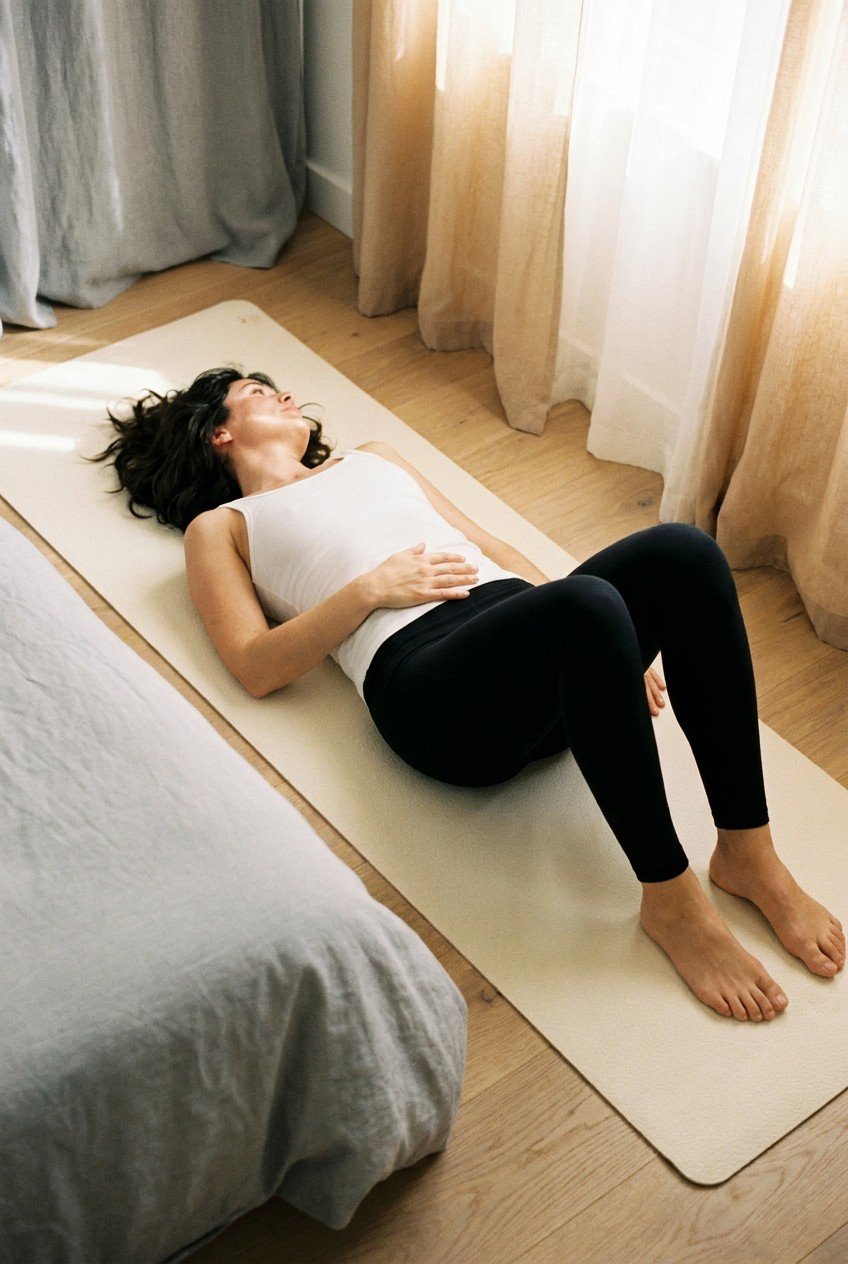
Lie on your back with your knees bent. Place one hand on your lower belly to monitor for abdominal tension. Contract the muscle you used to stop urination — a gentle lift and squeeze upward, inside the pelvis. Hold for 3–5 seconds. Release completely — let the muscle return to baseline before the next contraction. Breathe normally throughout. Your belly stays still. Your butt stays relaxed. Your thighs stay relaxed.
That’s one Kegel. Most people can’t hold for 5 seconds when they start. That’s normal. Build duration over time.
Goal: Build basic strength and control.
Exercise: Contract and hold for 3–5 seconds (or as long as you can without involving your abs, glutes, or thighs). Release completely for 5 seconds. Repeat 10 times. This is one set. Perform 3 sets per day.
Schedule: Daily. Any position works — lying down is easiest to start, seated is the next progression, standing is the most challenging. Start lying down. Graduate to seated and standing as your control improves.
What you’re learning: The hold duration will increase naturally as the muscle strengthens. By week 4, most people can hold for 8–10 seconds without recruiting accessory muscles.
Goal: Build fast-twitch responsiveness — the ability to contract and release rapidly.
Exercise: Contract and release as quickly as possible — 1 second squeeze, 1 second release. Repeat 10 times as fast as you can. This is one set. Perform 3 sets per day.
Why this matters: The orgasmic contractions of the pelvic floor are rapid — 5–8 contractions, each about 0.8 seconds apart. Slow-hold Kegels build strength. Fast-twitch Kegels build the kind of power that intensifies orgasm specifically.
Goal: Build gradation control — the ability to contract at different intensities.
Exercise: Imagine your pelvic floor is an elevator. Contract gently to the “first floor” and hold for 3 seconds. Increase contraction to the “second floor” and hold. Increase to the “third floor” — full contraction — and hold. Then descend: third floor, second floor, first floor, fully release. One full elevator ride takes about 20–30 seconds.
Why this matters: Orgasm isn’t an on-off switch. It’s a gradient. The elevator exercise trains your nervous system to produce different levels of pelvic floor contraction on demand, which translates to better control of arousal and orgasm timing.
A Kegel is a contraction — lifting and squeezing inward. A reverse Kegel is a relaxation — releasing and lengthening the pelvic floor downward. It’s not bearing down forcefully. It’s a deliberate relaxation: the same muscle release that happens when you begin urination.
The pelvic floor can be too tight as easily as it can be too weak. Most Kegel advice assumes weakness, but hypertonic (too-tight) pelvic floor is common — particularly in:
A hypertonic pelvic floor causes: pain during penetration, difficulty orgasming, urinary urgency and frequency, constipation, and pelvic pain. Doing more Kegels makes it worse because you’re tightening an already-too-tight muscle.
Lie on your back with your knees bent. Place your hands on your lower belly. Inhale deeply into your belly — let it expand into your hands. As you inhale, the diaphragm descends, and the pelvic floor naturally relaxes and lengthens. Focus on the sensation of release at the pelvic floor — a gentle downward opening, as if you’re about to urinate or pass gas.
Do not bear down forcefully. The sensation is relaxation, not expulsion. A proper reverse Kegel feels like a release of tension downward, not a push.
Exercise: Inhale — feel the pelvic floor release. Exhale — allow it to return to baseline. 10 breaths. This is one set. 2–3 sets per day.
If you experience pain during penetration, you should try reverse Kegels before strengthening Kegels. If you have symptoms of urinary urgency, pelvic pain, or constipation, see a pelvic floor physical therapist for assessment — you may have a hypertonic pelvic floor that requires relaxation training, not strengthening.
If you’ve been doing Kegels for months and your symptoms haven’t improved, you’re probably doing them wrong — or the problem is tightness, not weakness. See a pelvic floor PT.
Weighted silicone or glass balls inserted into the vagina. The pelvic floor must contract to hold them in place, providing resistance training.
How they work: Insert one or two balls. Stand up. Gravity pulls the balls downward. Your pelvic floor automatically contracts to hold them in place. This is passive training — the muscle works without you consciously contracting it.
What to look for:
Usage: Wear for 15–30 minutes while moving around — walking, light housework, standing. Do not wear for extended periods (hours) or during sleep. Remove and clean after each use.
The evidence: Kegel balls improve pelvic floor strength in studies of women with stress urinary incontinence. The benefit for orgasm quality is mostly anecdotal but biologically plausible — a stronger pelvic floor contracts more forcefully during orgasm.
Electronic devices inserted vaginally that measure pelvic floor contraction strength and display it on an app. They gamify Kegel training — you squeeze in response to visual cues and see your contraction strength in real time.
What they’re good for: People who can’t tell if they’re contracting correctly. The biofeedback confirms that you’re contracting the right muscle and shows you whether your strength is improving. Good for motivation — the gamification makes daily training less tedious.
What they’re not good for: Replacing a pelvic floor physical therapist. Biofeedback devices can tell you how hard you’re squeezing, but they can’t tell you if your pelvic floor is hypertonic, if you’re recruiting the wrong muscles, or if you need reverse Kegels instead of Kegels.
Representative products: Elvie Trainer, Perifit, kGoal. All in the $100–200 range. Not essential for most people, but useful if you struggle with form or motivation.
Weighted cones inserted vaginally, held in place by pelvic floor contraction. Similar principle to Kegel balls but typically with a single weighted insert.
Who they’re for: People who prefer a simpler form factor than Kegel balls and want progressive weight training. The cone shape centers the weight differently than round balls.
A pressure-sensing device (air-filled probe or electronic sensor) that measures pelvic floor contraction force in centimeters of water pressure (cmH₂O) or millibars. Used primarily in clinical settings by pelvic floor PTs.
Not for home use generally. A perineometer provides the most accurate measurement of pelvic floor strength, but requires training to use and interpret. If your pelvic floor PT uses one, great. Don’t buy one for home unless directed by your provider.
Multiple studies have found a correlation between pelvic floor strength and orgasm quality. Women with stronger pelvic floor muscles report more intense orgasms and are more likely to experience orgasm from penetration. The mechanism is straightforward: orgasm involves rhythmic contractions of the pelvic floor. A stronger muscle contracts more forcefully, producing more intense sensation.
One 2018 study in the Journal of Sexual Medicine found that women who completed an 8-week pelvic floor training program reported significant improvements in orgasm intensity, frequency, and satisfaction compared to a control group. The effect was dose-dependent — more training = more improvement.
The caveat: The relationship between pelvic floor strength and orgasm is real but not universal. Some women with strong pelvic floors don’t orgasm from penetration. Orgasm is neurological and psychological as much as muscular. Pelvic floor training increases the muscle component. It doesn’t guarantee a specific type of orgasm.
The bulbospongiosus muscle — part of the pelvic floor — surrounds the base of the penis and the urethra. It contracts rhythmically during ejaculation and helps maintain erection rigidity by compressing the veins that drain blood from the penis. A weak pelvic floor contributes to weaker erections and reduced ejaculatory force.
A 2019 meta-analysis found that pelvic floor muscle training significantly improved erectile function in men with erectile dysfunction, with effects comparable to PDE5 inhibitors (Viagra-type medications) for mild to moderate ED. The mechanism: stronger pelvic floor muscles → better venous compression → firmer erections.
For premature ejaculation: pelvic floor training — specifically learning to relax the pelvic floor (reverse Kegels) during high arousal — is a first-line treatment. The pelvic floor tenses involuntarily as ejaculation approaches. Learning to consciously relax it at that moment can delay ejaculation. Multiple RCTs have found pelvic floor training to be effective for premature ejaculation, with success rates of 60–80% in some studies.
Pregnant people should do Kegels throughout pregnancy unless directed otherwise by their provider. Postpartum Kegels should begin as soon as comfortable after delivery — typically within the first week for vaginal delivery, after clearance from the provider for cesarean delivery.
Specific postpartum considerations:
Declining estrogen in perimenopause and menopause thins the vaginal and pelvic tissues. The pelvic floor may weaken. The risk of pelvic organ prolapse and stress urinary incontinence increases. Kegels are more important, not less — but the thinning tissue may feel different, and you may need to adjust technique or reduce intensity.
Vaginal estrogen (local, not systemic) can improve pelvic floor function in postmenopausal women by maintaining tissue thickness and blood flow. If Kegels feel less effective after menopause, discuss vaginal estrogen with your provider in addition to pelvic floor training.
The pelvic floor naturally weakens with age, contributing to erectile changes and post-void dribbling. Kegels are recommended for men after prostate surgery (prostatectomy) — incontinence after prostate removal is primarily due to pelvic floor disruption, and pelvic floor training is the standard rehabilitation protocol.
A pelvic floor PT will:
Pelvic floor PT is one of the most underutilized specialties in medicine. Most people who need it don’t know it exists. If you have any of the symptoms above, ask your primary care provider or gynecologist for a referral.
Your pelvic floor is the muscle group that controls your orgasm contractions, your erection firmness, your bladder and bowel function, and — for people who give birth — your postpartum recovery. And most people have never been taught what it is, where it is, or how to train it.
The protocol is simple: Stage 1 endurance (hold 3–5 seconds, 10 reps, 3x daily), Stage 2 speed (rapid-fire 1-second contractions), Stage 3 the elevator (gradual contraction levels). Don’t forget the reverse Kegel — the relaxation that counterbalances the squeeze. And if Kegels hurt, or if you’ve been doing them for months with no improvement, see a pelvic floor PT. There’s an entire specialty dedicated to these muscles. Use it.
A stronger pelvic floor won’t guarantee you a different type of orgasm. But it will guarantee that whatever type of orgasm you have, it’ll be stronger. That’s worth 5 minutes a day.
Looking for training tools? Browse our Kegel exercisers and pelvic floor devices — everything is body-safe silicone grade and ships in plain packaging.
About the Author: Dr. Yuki Tanaka is a sexual health educator and clinical researcher at AmorSerere. She holds a PhD in human sexuality and has spent 15 years teaching people where their pelvic floor is — because almost nobody was shown. She considers the pelvic floor the most important muscle group in sexual health and the most undertrained muscle group in the human body, and she will talk about it until everyone listens.
Last Updated: July 26, 2026

Clinical sex educator with 10+ years experience. Specializes in body-safe materials and sexual wellness education.